world.wikisort.org - Japan
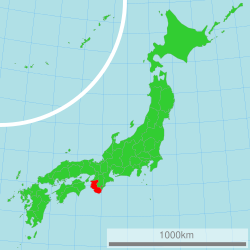
Wakayama Prefecture (和歌山県, Wakayama-ken) is a prefecture of Japan located in the Kansai region of Honshu.[1]: 1026 Wakayama Prefecture has a population of 944,320 (as of 1 October 2017[update]) and has a geographic area of 4,724 square kilometres (1,824 sq mi). Wakayama Prefecture borders Osaka Prefecture to the north, and Mie Prefecture and Nara Prefecture to the northeast.
Wakayama Prefecture
和歌山県 | |
|---|---|
Prefecture | |
| Japanese transcription(s) | |
| • Japanese | 和歌山県 |
| • Rōmaji | Wakayama-ken |
 Cherry blossoms bloom in the courtyard of Negoro-ji Temple in Iwade City, Wakayama Prefecture | |
 Flag  Symbol | |
| Anthem: Wakayama kenminka | |
 | |
| Country | Japan |
| Region | Kansai |
| Island | Honshū |
| Capital | Wakayama (city) |
| Subdivisions | Districts: 6, Municipalities: 30 |
| Government | |
| • Governor | Yoshinobu Nisaka |
| Area | |
| • Total | 4,724.69 km2 (1,824.21 sq mi) |
| • Rank | 30th |
| Population (1 October 2017) | |
| • Total | 944,320 |
| • Rank | 39th |
| • Density | 199.87/km2 (517.7/sq mi) |
| • Dialects | Kishū |
| ISO 3166 code | JP-30 |
| Website | www.wakayama.lg.jp/ english/ |
| Symbols | |
| Bird | Japanese white-eye (Zosterops japonica) |
| Flower | Ume blossom (Prunus mume) |
| Tree | Ubame oak (Quercus phillyraeoides) |
Wakayama is the capital and largest city of Wakayama Prefecture, with other major cities including Tanabe, Hashimoto, and Kinokawa.[2]: 1025 Wakayama Prefecture is located on the western coast of the Kii Peninsula on the Kii Channel, connecting the Pacific Ocean and Seto Inland Sea, across from Tokushima Prefecture on the island of Shikoku.
History
Present-day Wakayama is mostly the western part of the province of Kii.[3]
1953 flood disaster
On July 17–18, 1953, a torrential heavy rain occurred, followed by collapse of levees, river flooding and landslides in a wide area. Many bridges and houses were destroyed. According to an officially confirmed report by the Government of Japan, 1,015 people died, with 5,709 injured and 7,115 houses lost.[citation needed]
Geography
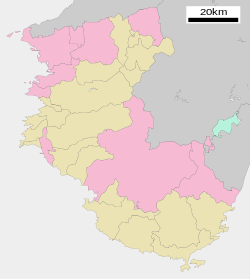
City Town Village
As of 31 March 2020, 13 percent of the total land area of the prefecture was designated as Natural Parks, namely the Setonaikai and Yoshino-Kumano National Parks; Kongō-Ikoma-Kisen and Kōya-Ryūjin Quasi-National Parks; and Enju Kaigan, Hatenashi Sanmyaku, Hikigawa, Jōgamori Hokodai, Kōyasanchō Ishimichi-Tamagawakyō, Kozagawa, Nishiarida, Oishi Kōgen, Ōtōsan, Ryūmonzan, Shiramisan-Wadagawakyō, and Shirasaki Kaigan Prefectural Natural Parks.[4]
Cities
Nine cities are in Wakayama Prefecture:
| Name | Area (km2) | Population | Map | |
|---|---|---|---|---|
| Rōmaji | Kanji | |||
 Arida Arida |
有田市 | 36.91 | 27,963 |  |
 Gobō Gobō |
御坊市 | 43.78 | 27,483 |  |
 Hashimoto Hashimoto |
橋本市 | 130.31 | 62,941 |  |
 Iwade Iwade |
岩出市 | 38.5 | 53,280 |  |
 Kainan Kainan |
海南市 | 101.18 | 51,112 |  |
 Kinokawa Kinokawa |
紀の川市 | 228.24 | 61,850 |  |
 Shingū Shingū |
新宮市 | 255.43 | 26,815 |  |
 Tanabe Tanabe |
田辺市 | 1,026.91 | 70,410 |  |
 Wakayama (capital) Wakayama (capital) |
和歌山市 | 210.25 | 360,664 |  |
Towns and villages
These are the towns and villages in each district:
| Name | Area (km2) | Population | District | Type | Map | |
|---|---|---|---|---|---|---|
| Rōmaji | Kanji | |||||
 Aridagawa Aridagawa |
有田川町 | 351.77 | 26,245 | Arida District | Town |  |
 Hidaka Hidaka |
日高町 | 46.42 | 7,666 | Hidaka District | Town |  |
 Hidakagawa Hidakagawa |
日高川町 | 331.61 | 9,615 | Hidaka District | Town |  |
 Hirogawa Hirogawa |
広川町 | 65.35 | 7,059 | Arida District | Town |  |
 Inami Inami |
印南町 | 113.63 | 7,949 | Hidaka District | Town |  |
 Kamitonda Kamitonda |
上富田町 | 57.49 | 15,047 | Nishimuro District | Town |  |
 Katsuragi Katsuragi |
かつらぎ町 | 151.73 | 16,686 | Ito District | Town |  |
 Kimino Kimino |
紀美野町 | 128.31 | 8,989 | Kaisō District | Town |  |
 Kitayama Kitayama |
北山村 | 48.21 | 432 | Higashimuro District | Village |  |
 Kōya Kōya |
高野町 | 137.08 | 3,279 | Ito District | Town |  |
 Kozagawa Kozagawa |
古座川町 | 294.52 | 2,749 | Higashimuro District | Town |  |
 Kudoyama Kudoyama |
九度山町 | 44.19 | 4,295 | Ito District | Town |  |
 Kushimoto Kushimoto |
串本町 | 135.78 | 16,243 | Higashimuro District | Town |  |
 Mihama Mihama |
美浜町 | 12.79 | 7,391 | Hidaka District | Town |  |
 Minabe Minabe |
みなべ町 | 120.26 | 12,561 | Hidaka District | Town |  |
 Nachikatsuura Nachikatsuura |
那智勝浦町 | 183.45 | 17,261 | Higashimuro District | Town |  |
 Shirahama Shirahama |
白浜町 | 201.04 | 23,325 | Nishimuro District | Town |  |
 Susami Susami |
すさみ町 | 174.71 | 4,011 | Nishimuro District | Town |  |
 Taiji Taiji |
太地町 | 5.96 | 3,428 | Higashimuro District | Town |  |
 Yuasa Yuasa |
湯浅町 | 20.8 | 11,960 | Arida District | Town |  |
 Yura Yura |
由良町 | 30.74 | 5,738 | Hidaka District | Town |  |
Mergers
Demographics
Since 1996, population of Wakayama Prefecture has kept declining, and since 2010, it has been the only prefecture in Kansai region with population below 1,000,000. In 2017, Wakayama is ranked 40th by population in Japan with a population of 944,320.
Politics
List of governors of Wakayama
State-appointed governors:
|
|
Publicly-elected governors:
|
|
Culture
Mount Kōya (高野山, Kōya-san) in the Ito District is the headquarters of the Shingon sect of Japanese Buddhism. It is home to one of the first Japanese style Buddhist temples in Japan and remains a pilgrimage site and an increasingly popular tourist destination as people flock to see its ancient temples set amidst the towering cedar trees at the top of the mountain. The Sacred sites and pilgrimage routes in the Kii Mountain Range extend for miles throughout the prefecture and together have been recognized as Japan's 11th UNESCO World Heritage Site.[5]
The Kumano Shrines are on the southern tip of the prefecture. Tomogashima (a cluster of four islands) is part of the prefecture.
Agriculture
Orange
Wakayama Prefecture ranks first in the production of oranges in Japan. Wakayama has its own brand of oranges, which is produced in Arida District and called 'Arida-Orange'. Arida District, where oranges have been produced for more than 400 years,[6] yields about half of the orange crops in Wakayama today.[7] Furthermore, the yield of Arida-Oranges accounts for about 10 percent of Japanese domestic production of oranges.[8]
Japanese apricot (Ume)
According to the survey by the Ministry of Agriculture, Forestry and Fisheries of Japan, Wakayama stands first in the production of Japanese apricots (梅, Ume) in Japan. As of 2016, Wakayama made up about 70 percent of Japanese domestic production of Japanese apricots.[9]
Sister relationships
Wakayama Prefecture has friendship and sister relationships with six places outside Japan:[10]Shandong, People's Republic of China; Pyrénées-Orientales, France; Florida, United States; Sinaloa, Mexico; Galicia, Spain and Sichuan, People's Republic of China.
Tourism
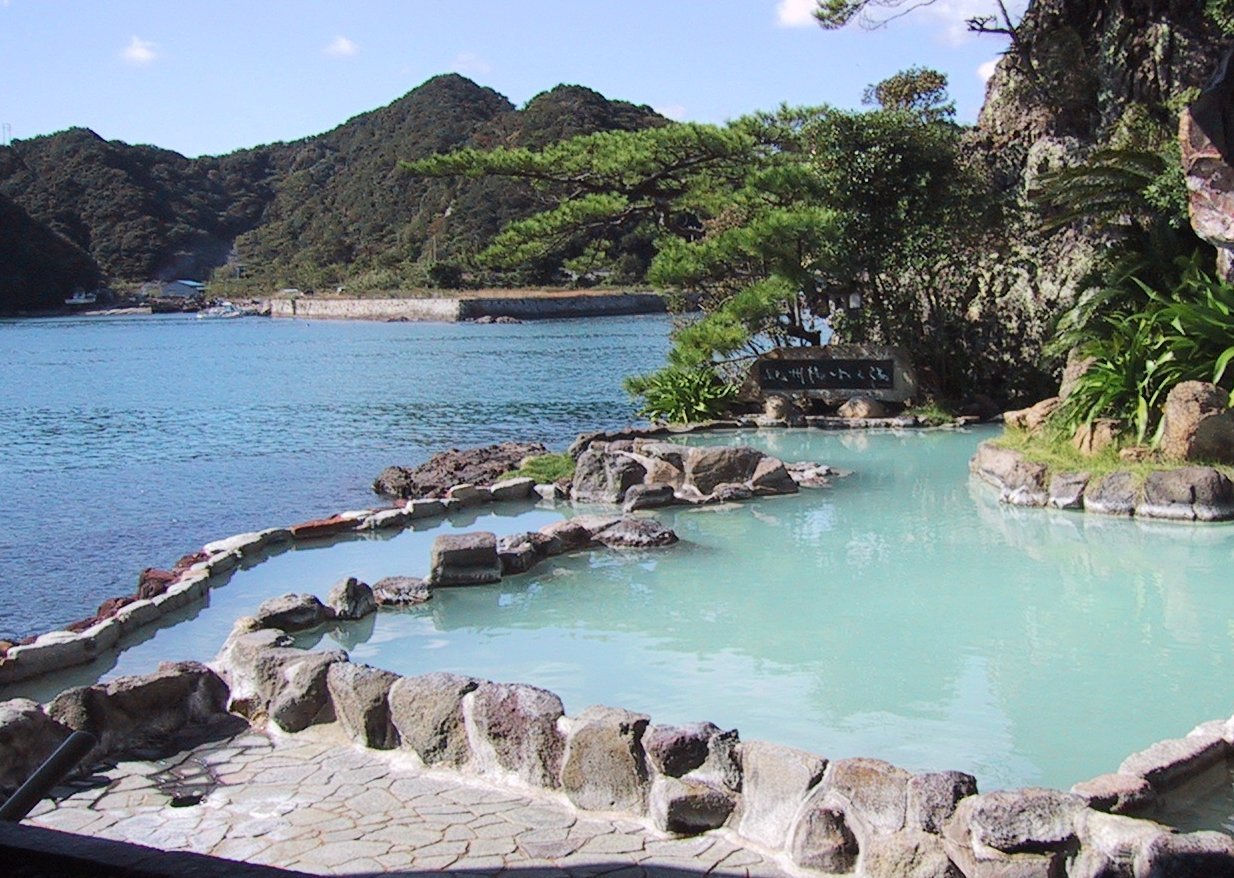
Wakayama Prefecture has hot springs such as Shirahama, Kawayu, and Yunomine Onsen.
 Saikazaki, Wakanoura
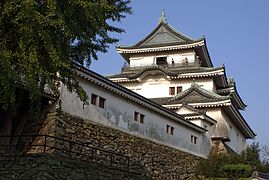 Wakayama Castle
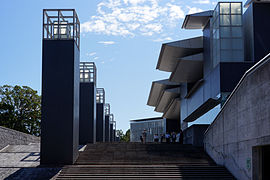 The Museum of Modern Art, Wakayama
 Konpon Daido
(Mount Kōya) Chōhō-ji
 Nanki-Katsuura Onsen
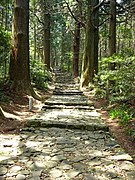 Daimonzaka
(Kumano Kodō)




Transportation
Rail
- JR West
- Hanwa Line
- Kinokuni Line
- Wakayama Line
- JR Central
- Kisei Line
- Nankai
- Nankai Line
- Koya Line
- Kada Line
- Kishu Railway
- Wakayama Electric Railway
Road
Expressway
- Hanwa Expressway
- Keinawa Expressway
- Yuasa Gobo Road
- Nachi Katsuura Road
National Highway
- Route 24
- Route 26
- Route 42
- Route 168 (Shingu-Gojo-Ikoma-Hirakata)
- Route 169 (Shingu-Kumano-Kawakami-Yoshino-Asuka-Kashihara-Nara)
- Route 311 (Kamitonda-Tanabe-Shingu-kumano-Owase)
- Route 370 (Kainan-Hashimoto-Gojo-Uda-Nara)
- Route 371 (Kawachinagano-Hashimoto-Koya-Kushimoto)
- Route 424
Ferry
- Wakayama-Tokushima
Airport
- Nanki Shirahama Airport
Education
Universities
- Wakayama University
- Koyasan University
- Kinki University
- Wakayama Medical University
Notes
- Nussbaum, Louis-Frédéric. (2005). "Wakayama prefecture" in Japan Encyclopedia, p. 1026, p. 1026, at Google Books; "Kansai" in p. 477, p. 477, at Google Books.
- Nussbaum, "Wakayama" in p. 1025, p. 1025, at Google Books.
- Nussbaum, "Provinces and prefectures" in p. 780, p. 780, at Google Books.
- 自然公園都道府県別面積総括 [General overview of area figures for Natural Parks by prefecture] (PDF) (in Japanese). Ministry of the Environment. 31 March 2020. Retrieved 23 January 2020.
- UNESCO.org
- 今月の旬 Wakayama Prefecture website, accessed May 31, 2017
- 農林水産 特産品 Wakayama Prefecture website, accessed May 31, 2017
- 有田みかんについて JA Arida website, accessed May 31, 2017
- 作況調査(果樹): 農林水産省 The Ministry of Agriculture, Forestry and Fisheries website, accessed June 1, 2017
- 友好・姉妹提携 Archived 2011-06-11 at the Wayback Machine Wakayama Prefecture website, retrieved May 16, 2008
References
- Nussbaum, Louis-Frédéric and Käthe Roth. (2005). Japan encyclopedia. Cambridge: Harvard University Press. ISBN 978-0-674-01753-5; OCLC 58053128
External links

Wakayama (capital) | ||
| Core city |  | |
| Cities | ||
| Districts | ||
List of mergers in Wakayama Prefecture | ||

Regions and administrative divisions of Japan | |||||||||||||||||
|---|---|---|---|---|---|---|---|---|---|---|---|---|---|---|---|---|---|
| |||||||||||||||||
| Regions | 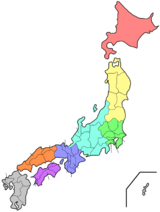 | ||||||||||||||||
| 47 Prefectures |
| ||||||||||||||||
| |||||||||||||||||
Authority control | |
|---|---|
| General | |
| National libraries | |
| Scientific databases | |
| Other |
|

На других языках
[de] Präfektur Wakayama
Die Präfektur Wakayama (jap. 和歌山県, Wakayama-ken) ist eine der Präfekturen Japans. Sie liegt in der Region Kinki auf der Insel Honshū. Ihr Verwaltungssitz ist Wakayama.- [en] Wakayama Prefecture
[ru] Вакаяма (префектура)
Вакая́ма (яп. 和歌山県 Вакаяма-кэн) — префектура, занимающая южную часть полуострова Кии в регионе Кинки острова Хонсю в Японии. Административный центр — город Вакаяма. Площадь префектуры составляет 4726,29 км²[1], население — 972 123 человека (1 августа 2014)[2], плотность населения — 205,68 чел./км².Другой контент может иметь иную лицензию. Перед использованием материалов сайта WikiSort.org внимательно изучите правила лицензирования конкретных элементов наполнения сайта.
WikiSort.org - проект по пересортировке и дополнению контента Википедии