world.wikisort.org - France
Villeneuve-lès-Avignon (French pronunciation: [vil'nœv lez‿avi'ɲɔ̃]; Provençal: Vilanòva d’Avinhon) is a commune in the Gard department in southern France. It can also be spelled Villeneuve-lez-Avignon.
Villeneuve-lès-Avignon | |
|---|---|
Commune | |
 Fort Saint-André on Mont Andaon | |
 Coat of arms | |
Location of Villeneuve-lès-Avignon  | |
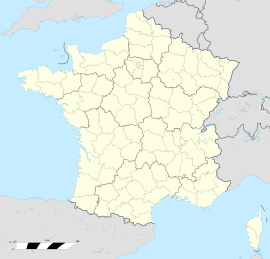  Villeneuve-lès-Avignon  Villeneuve-lès-Avignon | |
| Coordinates: 43°58′02″N 4°47′48″E | |
| Country | France |
| Region | Occitania |
| Department | Gard |
| Arrondissement | Nîmes |
| Canton | Villeneuve-lès-Avignon |
| Intercommunality | CA Grand Avignon |
| Government | |
| • Mayor (2020–2026) | Pascale Bories[1] |
| Area 1 | 18.27 km2 (7.05 sq mi) |
| Population | 12,216 |
| • Density | 670/km2 (1,700/sq mi) |
| Time zone | UTC+01:00 (CET) |
| • Summer (DST) | UTC+02:00 (CEST) |
| INSEE/Postal code | 30351 /30400 |
| Elevation | 10–181 m (33–594 ft) (avg. 25 m or 82 ft) |
| 1 French Land Register data, which excludes lakes, ponds, glaciers > 1 km2 (0.386 sq mi or 247 acres) and river estuaries. | |
History
In the 6th century the Benedictine abbey of St André was founded on Mount Andaon, and the village which grew up round it took its name.[3] The city itself was founded by Philippe le Bel and boasts a castle he built, Fort Saint-André.
The town was also the resort of the French cardinals during the sojourn of the popes at Avignon, in the 14th century.[3]
Geography
It is located on the right (western) bank of the river Rhône, opposite Avignon.
Population
|
| ||||||||||||||||||||||||||||||||||||||||||||||||||||||||||||||||||||||||||||||||||||||||||||||||||||||||||||||||||
| Source: EHESS[4] and INSEE (1968-2017)[5] | |||||||||||||||||||||||||||||||||||||||||||||||||||||||||||||||||||||||||||||||||||||||||||||||||||||||||||||||||||
Sights
- Fort Saint-André, on a hill outside the town
- Tour Philippe Le Bel, 14th century
- The church of Notre Dame, dating from the 14th century, contains a rich marble altar and significant pictures.[3]
- Carthusian monastery Notre-Dame-du-Val-de-Bénédiction, founded in 1356 by Pope Innocent VI[3]
International relations
Villeneuve-lès-Avignon is twinned with:
 Rheinbach, Germany
 Gytheio, Greece
 San Miniato, Italy


Gallery
 Tour Philippe Le Bel
 Fort Saint-André
 Chartreuse du Val de Bénédiction
 Collapsed apse of church, Chartreuse du Val de Bénédiction
 Cloister of Saint John, Chartreuse du Val de Bénédiction
 Chapel of the frescos, Chartreuse du Val de Bénédiction
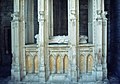 Tomb of Pope Innocent VI, Chartreuse du Val de Bénédiction


See also
- Communes of the Gard department
- Pont d'Avignon
References
- "Répertoire national des élus: les maires" (in French). data.gouv.fr, Plateforme ouverte des données publiques françaises. 13 September 2022.
- "Populations légales 2019". The National Institute of Statistics and Economic Studies. 29 December 2021.
- One or more of the preceding sentences incorporates text from a publication now in the public domain: Chisholm, Hugh, ed. (1911). "Villeneuve-lès-Avignon". Encyclopædia Britannica. Vol. 28 (11th ed.). Cambridge University Press. p. 85.
- Des villages de Cassini aux communes d'aujourd'hui: Commune data sheet Villeneuve-lès-Avignon, EHESS. (in French)
- Population en historique depuis 1968, INSEE

Further reading
- Fabrié, Marie-Luce (2000). "La collégiale Notre-Dame de Villeneuve-lez-Avignon". Congrès archéologique de France - Monuments du Gard, 157e session 1999 (in French). Paris: Société française d'archéologie. pp. 455–465.
- Labande, M. L.-H. (1910). "Villeneuve-lez-Avignon". Congrès archéologique de France, 76e session, 1909, Avignon. Volume 1 Guide du Congrès (in French). Paris: Picard. pp. 129–130.
- Labande, M. L.-H. (1910). "La Collégiale de Notre-Dame". Congrès archéologique de France, 76e session, 1909, Avignon. Volume 1 Guide du Congrès (in French). Paris: Picard. pp. 141–144.
- Labande, M. L.-H. (1910). "La Chartreuse". Congrès archéologique de France, 76e session, 1909, Avignon. Volume 1 Guide du Congrès (in French). Paris: Picard. pp. 144–158.
External links


Authority control | |
|---|---|
| General | |
| National libraries | |
| Other |
|

 | This Gard geographical article is a stub. You can help Wikipedia by expanding it. |
На других языках
[de] Villeneuve-lès-Avignon
Villeneuve-lès-Avignon (alternative Schreibweise: Villeneuve-lez-Avignon; okzitanisch Vilanòva d’Avinhon) ist eine Gemeinde im Département Gard, Region Okzitanien, Südost-Frankreich, mit 12.216 Einwohnern (Stand 1. Januar 2019). Sie ist die östlichste Gemeinde des Départements Gard und liegt gegenüber von Avignon am rechten Ufer der Rhône.- [en] Villeneuve-lès-Avignon
[es] Villeneuve-lès-Avignon
Villeneuve-lès-Avignon (en occitano: Vilanòva d'Avinhon) es una comuna francesa situada en el departamento de Gard, de la región de Occitania.[fr] Villeneuve-lès-Avignon
Villeneuve-lès-Avignon ou Villeneuve-lez-Avignon est une commune française située dans l'est du département du Gard, en région Occitanie. La ville est limitrophe d'Avignon et fait partie du Grand Avignon.[ru] Вильнёв-лез-Авиньон
Вильнёв-лез-Авиньон (фр. Villeneuve-lès-Avignon) — город во Франции, в регионе Лангедок — Руссильон, департамент Гар. Население составляет 12 463 человек (2009).Другой контент может иметь иную лицензию. Перед использованием материалов сайта WikiSort.org внимательно изучите правила лицензирования конкретных элементов наполнения сайта.
WikiSort.org - проект по пересортировке и дополнению контента Википедии