world.wikisort.org - France
Morschwiller (French pronunciation: [mɔʁʃvilɛʁ]; German: Morschweiler) is a commune in the Bas-Rhin department in Grand Est in north-eastern France.[3]
 | This article may be expanded with text translated from the corresponding article in French. (December 2008) Click [show] for important translation instructions.
|
Morschwiller | |
|---|---|
Commune | |
 The church in Morschwiller | |
 Coat of arms | |
Location of Morschwiller  | |
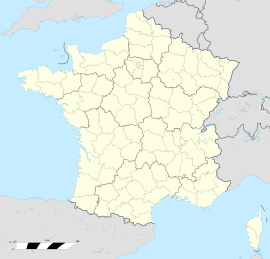  Morschwiller  Morschwiller | |
| Coordinates: 48°49′16″N 7°37′36″E | |
| Country | France |
| Region | Grand Est |
| Department | Bas-Rhin |
| Arrondissement | Haguenau-Wissembourg |
| Canton | Haguenau |
| Intercommunality | CA Haguenau |
| Government | |
| • Mayor (2021–2026) | Carine Steinmetz[1] |
| Area 1 | 4.62 km2 (1.78 sq mi) |
| Population | 576 |
| • Density | 120/km2 (320/sq mi) |
| Time zone | UTC+01:00 (CET) |
| • Summer (DST) | UTC+02:00 (CEST) |
| INSEE/Postal code | 67304 /67350 |
| Elevation | 194–302 m (636–991 ft) |
| 1 French Land Register data, which excludes lakes, ponds, glaciers > 1 km2 (0.386 sq mi or 247 acres) and river estuaries. | |
Etymology and names
The first written reference to Morschwiller's name was in 771 A.D., when it was called Moraswilari. Other historical names for the village include: Moresheim (840), Morinsheim (870), Morswilre (1372), Morsweyler (1666), and Morschweiler/Morschwiller by the 18th and 19th centuries.[4]
The willer/weiler (English: hamlet) suffix of Morschwiller comes from Middle High German wīler, from Old High German wīlāri, from Latin villa (“estate”).
See also
References
- "Répertoire national des élus: les maires" (in French). data.gouv.fr, Plateforme ouverte des données publiques françaises. 4 May 2022.
- "Populations légales 2019". The National Institute of Statistics and Economic Studies. 29 December 2021.
- INSEE commune file
- Batt, Ronald Elmer. The Chapel: A Comprehensive History of the Chapel and Pilgrimage of Our Lady Help of Christians, Cheektowaga, New York and of the Alsatian Immigrant Community at Williamsville, New York. Buffalo, NY: The Holling Press, Inc. p. 189.

Wikimedia Commons has media related to Morschwiller.


 | This Bas-Rhin geographical article is a stub. You can help Wikipedia by expanding it. |
На других языках
[de] Morschwiller
Morschwiller (deutsch Morschweiler) ist eine französische Gemeinde und liegt im Département Bas-Rhin in der Region Grand Est (bis 2015 Elsass). Sie hat 576 Einwohner (Stand 1. Januar 2019).- [en] Morschwiller
[ru] Моршвиллер
Моршвиллер (фр. Morschwiller) — коммуна на северо-востоке Франции в регионе Гранд-Эст[1] (бывший Эльзас — Шампань — Арденны — Лотарингия), департамент Нижний Рейн, округ Агно-Висамбур, кантон Агно[2].Текст в блоке "Читать" взят с сайта "Википедия" и доступен по лицензии Creative Commons Attribution-ShareAlike; в отдельных случаях могут действовать дополнительные условия.
Другой контент может иметь иную лицензию. Перед использованием материалов сайта WikiSort.org внимательно изучите правила лицензирования конкретных элементов наполнения сайта.
Другой контент может иметь иную лицензию. Перед использованием материалов сайта WikiSort.org внимательно изучите правила лицензирования конкретных элементов наполнения сайта.
2019-2026
WikiSort.org - проект по пересортировке и дополнению контента Википедии
WikiSort.org - проект по пересортировке и дополнению контента Википедии