world.wikisort.org - France
Geispolsheim (French pronunciation: [ɡaispɔlsaim]; Alsatian: Gaispítze) is a commune in the Bas-Rhin department in Grand Est in north-eastern France.[2]
Geispolsheim
Gäispítze | |
|---|---|
Commune | |
 The town hall in Geispolsheim | |
 Coat of arms | |
Location of Geispolsheim  | |
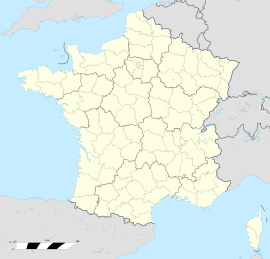  Geispolsheim  Geispolsheim | |
| Coordinates: 48°31′N 7°39′E | |
| Country | France |
| Region | Grand Est |
| Department | Bas-Rhin |
| Arrondissement | Strasbourg |
| Canton | Lingolsheim |
| Intercommunality | Strasbourg Eurométropole |
| Government | |
| • Mayor (2020–2026) | Jean-Michel Schaeffer |
| Area 1 | 21.95 km2 (8.47 sq mi) |
| Population | 7,561 |
| • Density | 340/km2 (890/sq mi) |
| Time zone | UTC+01:00 (CET) |
| • Summer (DST) | UTC+02:00 (CEST) |
| INSEE/Postal code | 67152 /67118 |
| Elevation | 139–155 m (456–509 ft) |
| 1 French Land Register data, which excludes lakes, ponds, glaciers > 1 km2 (0.386 sq mi or 247 acres) and river estuaries. | |
 | This article may be expanded with text translated from the corresponding article in French. (December 2008) Click [show] for important translation instructions.
|
Geography
Geispolsheim is positioned 12 kilometres (7 mi) to the south of Strasbourg.
The construction of a railway between Strasbourg and Mulhouse involved the building in 1841 of a station approximately 3 kilometres (2 mi) to the east of the little town: this was followed by the development around the new station of a separate little conurbation, albeit one that always remained a part of the commune of Geispolsheim. The newer settlement was known as 'Geispolsheim-Gare' (Geispolsheim-Station), and retains the name even though the station itself was demolished in 1992, while the original settlement is still unofficially referred to as 'Geispolsheim-Village'. The two parts of the little town are linked by the departmental road RD84.
Today included in the Strasbourg Eurométropole, Geispolsheim is well positioned for future expansion: it already offers significant local employment and commercial opportunities in its industrial and artisanal zones.
Population
| Year | Pop. | ±% p.a. |
|---|---|---|
| 1968 | 3,758 | — |
| 1975 | 4,625 | +3.01% |
| 1982 | 4,712 | +0.27% |
| 1990 | 5,546 | +2.06% |
| 1999 | 7,031 | +2.67% |
| 2007 | 7,067 | +0.06% |
| 2012 | 7,124 | +0.16% |
| 2017 | 7,540 | +1.14% |
| Source: INSEE[3] | ||
See also
References
- "Populations légales 2019". The National Institute of Statistics and Economic Studies. 29 December 2021.
- INSEE commune file
- Population en historique depuis 1968, INSEE


Authority control | |
|---|---|
| General | |
| National libraries | |
| Other |
|

 | This Bas-Rhin geographical article is a stub. You can help Wikipedia by expanding it. |
На других языках
[de] Geispolsheim
Geispolsheim ist eine französische Stadt mit 7561 Einwohnern (Stand 1. Januar 2019) in der Agglomeration um Straßburg im Département Bas-Rhin in der Europäischen Gebietskörperschaft Elsass und in der Region Grand Est.- [en] Geispolsheim
[ru] Гайспольсайм
Гайспольсайм (фр. Geispolsheim [gaɪspɔlsaɪm]) — коммуна на северо-востоке Франции в регионе Гранд-Эст[1] (бывший Эльзас — Шампань — Арденны — Лотарингия), департамент Нижний Рейн, округ Страсбур, кантон Ленгольсайм[2]. До марта 2015 года коммуна являлась административным центром одноимённого упразднённого кантона (округ Страсбур-Кампань).Другой контент может иметь иную лицензию. Перед использованием материалов сайта WikiSort.org внимательно изучите правила лицензирования конкретных элементов наполнения сайта.
WikiSort.org - проект по пересортировке и дополнению контента Википедии