world.wikisort.org - France
Basseneville is a commune in the Calvados department in the Normandy region of north-western France.[3]
Basseneville | |
|---|---|
Commune | |
 Town hall | |
Location of Basseneville  | |
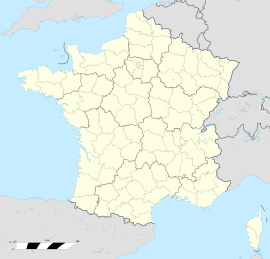  Basseneville 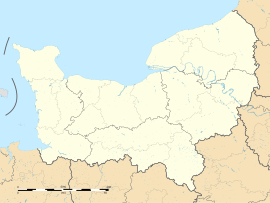 Basseneville | |
| Coordinates: 49°12′01″N 0°07′42″W | |
| Country | France |
| Region | Normandy |
| Department | Calvados |
| Arrondissement | Lisieux |
| Canton | Cabourg |
| Government | |
| • Mayor (2020–2026) | Patrice Germain[1] |
| Area 1 | 10.59 km2 (4.09 sq mi) |
| Population | 252 |
| • Density | 24/km2 (62/sq mi) |
| Time zone | UTC+01:00 (CET) |
| • Summer (DST) | UTC+02:00 (CEST) |
| INSEE/Postal code | 14045 /14670 |
| Elevation | 2–45 m (6.6–147.6 ft) (avg. 6 m or 20 ft) |
| 1 French Land Register data, which excludes lakes, ponds, glaciers > 1 km2 (0.386 sq mi or 247 acres) and river estuaries. | |
The inhabitants of the commune are known as Bassenevillais or Bassenevillaises.[4]
Geography
Basseneville is located in the Pays d'Auge some 12 km east of Caen and 8 km south-east of Cabourg. Access to the commune is by the D675 road from Goustranville in the east which passes through the south of the commune continuing south-west to Saint-Samson. The D224A also comes from Saint-Samson and passes through the commune continuing north-east to join the D224 just north-east of the commune. The A13 autoroute passes through the commune from east to west but has no exit - the nearest exit is Exit  29 Dozulé to the east of the commune which has no direct access the commune and Exit 30/31 to the south-west which connects to the D675. Apart from the village there are the hamlets of L'Église, Les Marettes, Saint-Richer, and La Chollerie. The commune is entirely farmland.[5][6]
The Dives river forms the north-western border of the commune as it flows north-east to join the sea at Cabourg. The Grand Canal forms the south-eastern border of the commune.[5][6]
Neighbouring communes and villages[5] | |
|---|---|


History
Basseneville appears as Bafneville on the 1750 Cassini Map[7] and as Bosneville on the 1790 version.[8]
A railway station on the Caen to Dozulé-Putot line existed in the commune from 1881 to 1938. The line that passed through the commune was finally closed in 1943.
Administration
 | This list is incomplete; you can help by adding missing items. (April 2021) |
List of Successive Mayors[9]
| From | To | Name | Party | Position |
|---|---|---|---|---|
| 1983 | 2008 | André Vardon | ||
| 2008 | 2014 | Jean-François Wantz | Retired | |
| 2014 | 2026[10][1] | Patrice Germain | Retired |
Demography
In 2017 the commune had 257 inhabitants.
|
| ||||||||||||||||||||||||||||||||||||||||||||||||||||||||||||||||||||||||||||||||||||||||||||||||||||||||||||||||||
| Source: EHESS[11] and INSEE[12] | |||||||||||||||||||||||||||||||||||||||||||||||||||||||||||||||||||||||||||||||||||||||||||||||||||||||||||||||||||
Culture and heritage
Religious heritage
The Chapel of Saint Richer contains several items that are registered as historical objects:
- A Chalice with Paten (18th century)
 [13]
[13] - A Trunk (17th century)[14]
- A Painting with frame: Crucifixion (17th century)[15]

The Parish Church of Notre-Dame also contains several items that are registered as historical objects:
- A Tabernacle (17th century)[16]
- A Painting: The Holy Family (18th century)[17]
- A Painting with frame: Holy Family (18th century)[18]
- An Altar, Retable, and 2 doors (1719)[19]
- A Lectern (1721)[20]
Notable people linked to the commune
- Jean-Victor Durand-Duquesnay (1785 at Basseneville - 1862), Normandy botanist
- Pierre (François-Amand) Bazin (1796 at Basseneville - 1865)
See also
References
- "Répertoire national des élus: les maires". data.gouv.fr, Plateforme ouverte des données publiques françaises (in French). 2 December 2020.
- "Populations légales 2019". The National Institute of Statistics and Economic Studies. 29 December 2021.
- INSEE commune file
- Inhabitants of Calvados (in French)
- Basseneville on Google Maps
- Basseneville on the Géoportail from National Geographic Institute (IGN) website (in French)
- Bafneville on the 1750 Cassini Map
- Bosneville on the 1790 Cassini Map
- List of Mayors of France (in French)
- Patrice Germain, new mayor, succeeds Jean-François Wantz, Ouest-France, consulted on 1 February 2015 (in French)
- Des villages de Cassini aux communes d'aujourd'hui: Commune data sheet Basseneville, EHESS. (in French)
- Population en historique depuis 1968, INSEE
- Ministry of Culture, Palissy PM14000044 Chalice with Paten
 (in French)
 - Ministry of Culture, Palissy PM14000043 Trunk (in French)
- Ministry of Culture, Palissy PM14000042 Painting: Crucifixion (in French)
- Ministry of Culture, Palissy PM14001090 Tabernacle (in French)
- Ministry of Culture, Palissy PM14000041 Painting: The Holy Family (in French)
- Ministry of Culture, Palissy PM14000040 Painting: Holy Family (in French)
- Ministry of Culture, Palissy PM14000039 Altar, Retable, and 2 doors (in French)
- Ministry of Culture, Palissy PM14000038 Lectern (in French)


На других языках
[de] Basseneville
Basseneville ist eine französische Gemeinde im Département Calvados in der Region Normandie. Sie gehört zum Arrondissement Lisieux und zum Kanton Cabourg.- [en] Basseneville
[ru] Басневиль
Басневи́ль (фр. Basseneville) — коммуна во Франции, находится в регионе Нижняя Нормандия. Департамент коммуны — Кальвадос. Входит в состав кантона Дозюле. Округ коммуны — Лизьё.Другой контент может иметь иную лицензию. Перед использованием материалов сайта WikiSort.org внимательно изучите правила лицензирования конкретных элементов наполнения сайта.
WikiSort.org - проект по пересортировке и дополнению контента Википедии