world.wikisort.org - France
Terrasson-Lavilledieu (French pronunciation: [tɛʁasɔ̃ lavildjø]; Occitan: Terrasson e La Vila Dieu) is a commune in the Dordogne department in Nouvelle-Aquitaine in southwestern France. The commune was created in 1963 by the merger of the former communes Terrasson and Lavilledieu.[2] Terrasson station has rail connections to Bordeaux, Périgueux and Brive-la-Gaillarde.
Terrasson-Lavilledieu | |
|---|---|
Commune | |
 A general view of Terrasson | |
 Coat of arms | |
Location of Terrasson-Lavilledieu  | |
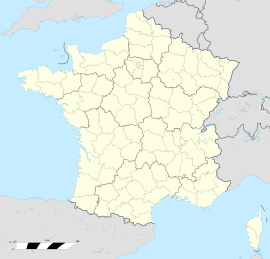  Terrasson-Lavilledieu 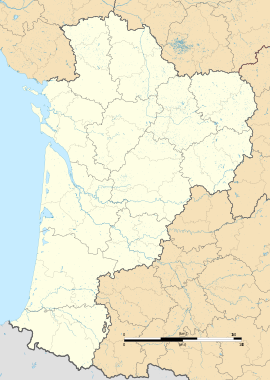 Terrasson-Lavilledieu | |
| Coordinates: 45°07′51″N 1°18′07″E | |
| Country | France |
| Region | Nouvelle-Aquitaine |
| Department | Dordogne |
| Arrondissement | Sarlat-la-Canéda |
| Canton | Terrasson-Lavilledieu |
| Intercommunality | Terrassonnais en Périgord Noir Thenon Hautefort |
| Government | |
| • Mayor (2020–2026) | Jean Bousquet |
| Area 1 | 39.34 km2 (15.19 sq mi) |
| Population | 6,266 |
| • Density | 160/km2 (410/sq mi) |
| Time zone | UTC+01:00 (CET) |
| • Summer (DST) | UTC+02:00 (CEST) |
| INSEE/Postal code | 24547 /24120 |
| Elevation | 82–299 m (269–981 ft) (avg. 88 m or 289 ft) |
| 1 French Land Register data, which excludes lakes, ponds, glaciers > 1 km2 (0.386 sq mi or 247 acres) and river estuaries. | |
Population
The population data given in the table below for 1962 and earlier refer to the former commune of Terrasson.
|
| ||||||||||||||||||||||||||||||||||||||||||||||||||||||||||||||||||||||||||||||||||||||||||||||||||||||||||||||||||
| Source: EHESS[2] and INSEE (1968-2017)[3] | |||||||||||||||||||||||||||||||||||||||||||||||||||||||||||||||||||||||||||||||||||||||||||||||||||||||||||||||||||
Sights

The Gardens of the Imagination (Les Jardins de l'Imaginaire)—classified as a remarkable garden by the French Ministry of Culture—are situated in Terrasson.[4] It was designed in 1996 by landscape architect Kathryn Gustafson to present thirteen tableaux of the myths and legends of the history of gardens. It uses simple natural elements; trees, flowers, water and stone to suggest the passage of mankind from nature to agriculture to the city. It uses a symbolic sacred wood, a rose garden, topiary art, and fountains to tell the story.[5]
See also
References
- "Populations légales 2019". The National Institute of Statistics and Economic Studies. 29 December 2021.
- Des villages de Cassini aux communes d'aujourd'hui: Commune data sheet Terrasson-Lavilledieu, EHESS. (in French)
- Population en historique depuis 1968, INSEE
- Base Mérimée: Jardin de l'imaginaire, Ministère français de la Culture. (in French)
- "Les Jardins de l'Imaginaire" (in French). Comité des Parcs et Jardins de France. Retrieved 26 December 2008.
External links

- "Terrasson". Office of Tourism. Retrieved 26 December 2008.


 | This Dordogne geographical article is a stub. You can help Wikipedia by expanding it. |
На других языках
[de] Terrasson-Lavilledieu
Terrasson-Lavilledieu ist eine französische Gemeinde mit 6266 Einwohnern (Stand 1. Januar 2019) im Département Dordogne in der Region Nouvelle-Aquitaine.- [en] Terrasson-Lavilledieu
[es] Terrasson-Lavilledieu
Terrasson-Lavilledieu (en occitano Terrasson e La Vila Dieu) es una comuna y población de Francia, en la región de Nueva Aquitania, departamento de Dordoña, en el distrito de Sarlat-la-Canéda. Es el chef-lieu y mayor población del cantón de su nombre.Другой контент может иметь иную лицензию. Перед использованием материалов сайта WikiSort.org внимательно изучите правила лицензирования конкретных элементов наполнения сайта.
WikiSort.org - проект по пересортировке и дополнению контента Википедии