world.wikisort.org - Philippines
Lucban, officially the Municipality of Lucban (Tagalog: Bayan ng Lukban), is a 2nd class municipality in the province of Quezon, Philippines. According to the 2020 census, it has a population of 53,091 people. [4]
Lucban | |
|---|---|
Municipality | |
| Municipality of Lucban | |
     Municipal Hall, Kamay Ni Hesus Healing Shrine, Saint Louis of Toulouse Parish Church, Downtown area, Plaza | |
 Seal | |
Nicknames:
| |
| Motto: Yanong Rikit! Baling Ganda! | |
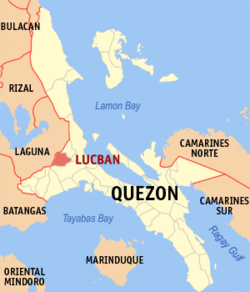 Map of Quezon with Lucban highlighted | |
OpenStreetMap  | |
  Lucban Location within the Philippines | |
| Coordinates: 14°06′48″N 121°33′25″E | |
| Country | Philippines |
| Region | Calabarzon |
| Province | Quezon |
| District | 1st district |
| Founded | August 19, 1578[1] |
| Barangays | 32 (see Barangays) |
| Government | |
| • Type | Sangguniang Bayan |
| • Mayor | Agustin M. Villaverde |
| • Vice Mayor | Arnel C. Abcede |
| • Representative | Wilfrido Mark M. Enverga |
| • Municipal Council | Members |
| • Electorate | 35,705 voters (2022) |
| Area | |
| • Total | 130.46 km2 (50.37 sq mi) |
| Elevation | 521 m (1,709 ft) |
| Highest elevation | 1,872 m (6,142 ft) |
| Lowest elevation | 252 m (827 ft) |
| Population | |
| • Total | 53,091 |
| • Density | 410/km2 (1,100/sq mi) |
| • Households | 12,692 |
| Economy | |
| • Income class | 2nd municipal income class |
| • Poverty incidence | 3.99% (2018)[5] |
| • Revenue | ₱217,723,848.18 (2020) |
| • Assets | ₱481,566,982.08 (2020) |
| • Expenditure | ₱193,790,592.13 (2020) |
| • Liabilities | ₱133,682,499.62 (2020) |
| Service provider | |
| • Electricity | Manila Electric Company (Meralco) |
| • Water | Apolinario Dela Cruz Waterworks System |
| • Telecommunications |
|
| • Cable TV | BANAHAW CATV |
| Time zone | UTC+8 (PST) |
| ZIP code | 4328 |
| PSGC | |
| IDD : area code | +63 (0)42 |
| Native languages | Tagalog |
| Website | www |
Lucban is dubbed as the Art Capital, Dance Capital and Rice Capital of Quezon province. It is accessible by land from Metro Manila passing through Rizal Province, via Manila East Road or via the South Luzon Expressway with approximately 2-3 hours drive.
The municipality is known for its annual Pahiyas Festival, which is held every May 19 in honor of San Isidro Labrador and known also as the 'Baguio' counterpart of Quezon, Province.
Etymology
Legend - poetically in "Ode to Lucban" - has it the town derives its name from the lukbán or pomelo tree. Three hunters from neighbouring Majayjay— namely Marcos Tigla, Luis Gamba and Lucas Mañawa— lost their way following the trail of wild animals at the foot of volcanic Mount Banahaw. Resting under a tree, they saw a crow (uwák) in the tree's branches, and believing this to be a bad omen, they moved to another place and rested again. Whilst in the shade of a large pomelo (lucbán) tree, the trio were attracted to a couple of kingfishers (salacsác) that were singing. Fascinated by the bird's plumage and rhythmic chirps, the superstitious hunters took this a sign of good fortune and thus settled in the place they named "Lucbán."
History
Second World War and Japanese Occupation
Early in the campaign, Japanese forces invaded and occupied Lucban. On December 26, 1941, Filipino and American troops defended Barrio Piis and the attack by the Japanese shifted to the Bataan Peninsula. After Japanese forces occupied the town, they built a military garrison and Japanese armed forces were stationed in Lucban. Both local guerrilla and regular troops of the Philippine Commonwealth Army initiated attacks in Lucban from 1942 to 1945.
Sampaloc, Quezon
Sampaloc used to be the Barrio Dingin of Lucban, Quezon consisting of three sitios. It was later renamed into Sampaloc because of the presence of a large tamarind tree found in the center of the settlement during the earlier days. The name was also changed in Alfonso Trece for a time to honor the King of Spain. In 1873, Capt. Pedro Cadelina of Lucban recommended to change the barrio into a municipality but due to lack of residents, it was only made into a “visita”. “Teniente Mayores” were appointed to head the ”visita”, the first of whom was from Polilio, followed by Arcadio Veluya, Laureano Nanola, Silverio Abueva and Juan Saludades. Through the efforts of Juan Pineda, Sampaloc became a municipality in 1892. He was elected as the first Capitan. He was succeeded by Diego Gagan followed by Teofilo Daya in 1901. During Daya's term in the office, three more barrios from Mauban – Banot, Bilucao and San Bueno, became a part of Sampaloc through the efforts of Ireneo Domeo, the municipal secretary. The town was also renamed to Sampaloc during this time.
Geography
Barangays
Lucban is politically subdivided into 32 barangays.
- Abang
- Aliliw
- Atulinao
- Ayuti (Poblacion)
- Barangay 1 (Poblacion)
- Barangay 2 (Poblacion)
- Barangay 3 (Poblacion)
- Barangay 4 (Poblacion)
- Barangay 5 (Poblacion)
- Barangay 6 (Poblacion)
- Barangay 7 (Poblacion)
- Barangay 8 (Poblacion)
- Barangay 9 (Poblacion)
- Barangay 10 (Poblacion)
- Igang
- Kabatete
- Kakawit
- Kalangay
- Kalyaat
- Kilib
- Kulapi
- Mahabang Parang
- Malupak
- Manasa
- May-It
- Nagsinamo
- Nalunao
- Palola
- Piis
- Samil
- Tiawe
- Tinamnan
Climate
| Climate data for Lucban, Quezon | |||||||||||||
|---|---|---|---|---|---|---|---|---|---|---|---|---|---|
| Month | Jan | Feb | Mar | Apr | May | Jun | Jul | Aug | Sep | Oct | Nov | Dec | Year |
| Average high °C (°F) | 24 (75) |
25 (77) |
27 (81) |
29 (84) |
29 (84) |
28 (82) |
27 (81) |
26 (79) |
26 (79) |
26 (79) |
26 (79) |
24 (75) |
26 (80) |
| Average low °C (°F) | 18 (64) |
18 (64) |
18 (64) |
19 (66) |
21 (70) |
22 (72) |
21 (70) |
21 (70) |
21 (70) |
20 (68) |
20 (68) |
19 (66) |
20 (68) |
| Average precipitation mm (inches) | 52 (2.0) |
35 (1.4) |
27 (1.1) |
27 (1.1) |
82 (3.2) |
124 (4.9) |
163 (6.4) |
144 (5.7) |
145 (5.7) |
141 (5.6) |
100 (3.9) |
102 (4.0) |
1,142 (45) |
| Average rainy days | 12.0 | 8.1 | 8.8 | 9.7 | 17.9 | 22.6 | 26.2 | 24.5 | 24.6 | 22.0 | 16.7 | 14.9 | 208 |
| Source: Meteoblue[6] | |||||||||||||
Demographics
| Year | Pop. | ±% p.a. |
|---|---|---|
| 1903 | 10,227 | — |
| 1918 | 12,913 | +1.57% |
| 1939 | 13,976 | +0.38% |
| 1948 | 15,060 | +0.83% |
| 1960 | 17,452 | +1.24% |
| 1970 | 23,157 | +2.87% |
| 1975 | 23,044 | −0.10% |
| 1980 | 25,826 | +2.30% |
| 1990 | 30,130 | +1.55% |
| 1995 | 35,128 | +2.92% |
| 2000 | 38,834 | +2.17% |
| 2007 | 45,616 | +2.24% |
| 2010 | 46,698 | +0.86% |
| 2015 | 51,475 | +1.87% |
| 2020 | 53,091 | +0.61% |
| Source: Philippine Statistics Authority [7] [8] [9][10] | ||
Economy
Government

Elected officials
Municipal council (2022-2025):[18]
| Position | Name |
|---|---|
| Municipal Mayor | Agustin M. Villaverde (PRP) |
| Vice Mayor | Arnel C. Abcede (PRP) |
| Councilors | Nikki Dominique Deveza (PRP) |
| Eduardo Alamo (NP) | |
| Aven Bince Rada (PRP) | |
| Lois Conrad Salumbides (NP) | |
| Nyerwina Pavino (PRP) | |
| Marife Hari (NPC) | |
| Maria Geraldine Halili (NPC) | |
| Mariano Ver Jr. (NPC) | |
| Virgilio Oblea (LBP) | |
| Arvin John Flores (SKP) |
Culture
Pahiyas festival
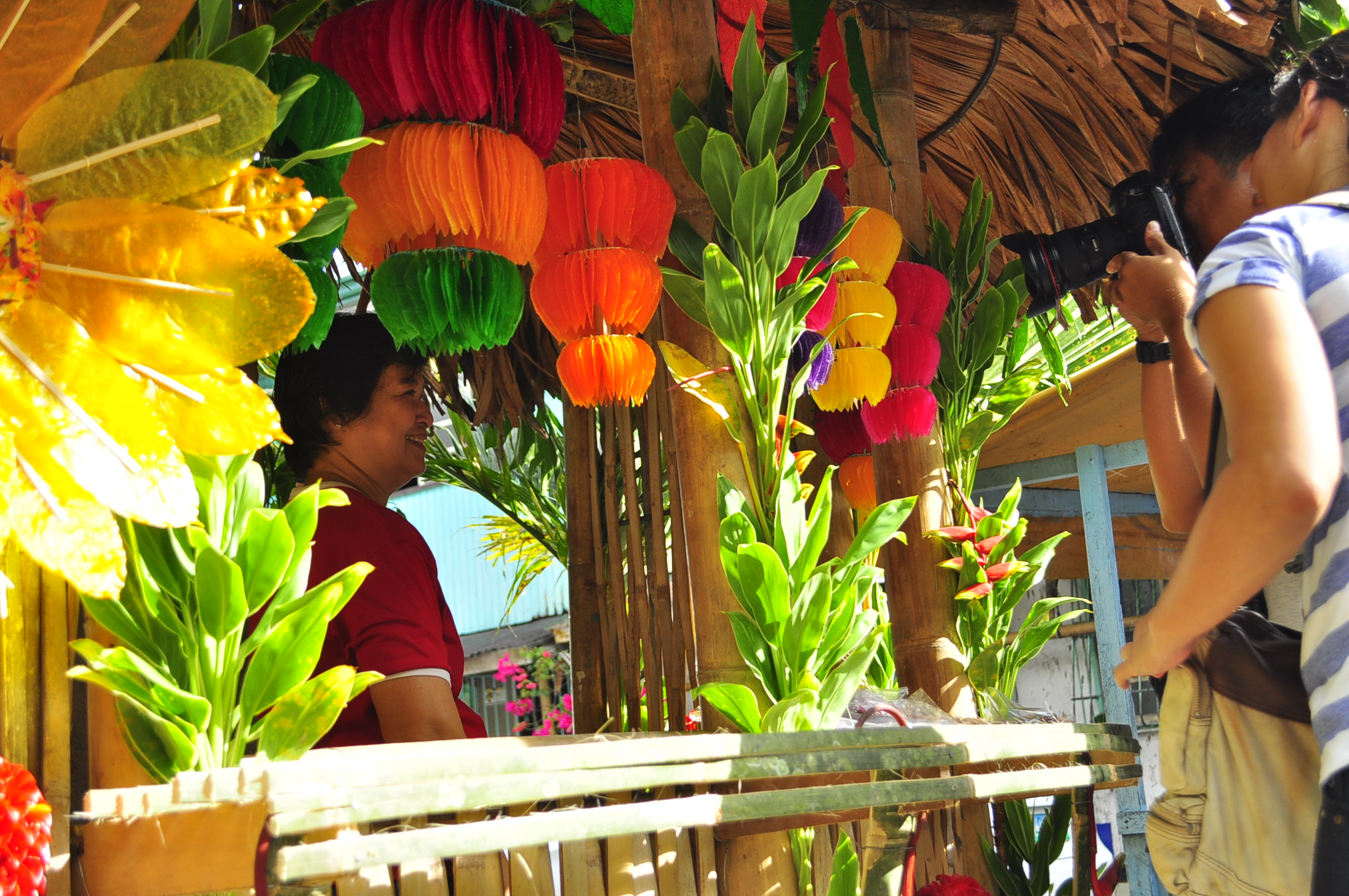
Lucban celebrates the Pahiyas Festival every May 15 in honor of the patron saint of farmers, St Isidore the Labourer. Beginning with a 6:00am mass at the Lucban Church,[19] this festival showcases a street of houses which are adorned with fruits, vegetables, agricultural products, handicrafts and kiping, a rice-made decoration, which afterwards can be eaten grilled or fried. The houses are judged and the best one is proclaimed the winner. Every year, tourists roam the municipality to witness the decoration of houses. Nowadays, Pahiyas Festival is a week long celebration starting every 15 May.[20][21]
Education
Public Research University
- Southern Luzon State University
College:
- Our Lady of the Most Holy Rosary Seminary
Secondary Schools:
- Casa del Niño Jesus de Lucban - High School
- Banahaw View Academy
- Lucban Academy
- One in Christ Church School of Lucban Inc.
- Paaralang Sekundarya ng Lucban Integrated School
- Nagsinamo National High School
- Lucban Christian School - Junior High School
Elementary Schools:
- Steadfast Love Kiddie School
- Casa Del Niño Jesus de Lucban
- Good Shepherd Diocesan School-Philippine Independent Church
- Paaralang Elementarya ng Lucban 1
- Paaralang Elementarya ng Lucban 2
- Paaralang Elementarya ng Lucban 3A
- Paaralang Elementarya ng Lucban 3B
- Paaralang Elementarya ng Lucban 4
- Paaralang Elementarya ng Lucban 5
- Paaralang Elementarya ng Lucban 6
- Paaralang Elementarya ng Lucban 7
- Paaralang Elementarya ng Lucban-Maka
- Paaralang Elementarya ng Lucban-May-it Manasa
- Paaralang Elementarya ng Lucban-Nagsinamo
- Paaralang Elementarya ng Lucban-Nakal
- Paaralang Elementarya ng Lucban-Piis
- Lucban Adventist Elementary School
- Lucban Christian School
Religious Landmarks
- Saint Louis Bishop Parish (Lucban Church)
- Kamay ni Hesus Shrine
Notable personalities
- Hermano Pule, religious leader who founded and led the Cofradía de San José.
- Angel Lagdameo, Archbishop of the Archdiocese of Jaro and former President of the Catholic Bishops' Conference of the Philippines
- Tommy Abuel, actor
- Pauline Mendoza, actress and model of GMA Network
- Fr. Joseph Faller, healing priest
- Rosauro "Uro" Q. Dela Cruz, TV and film director, mainly Bubble Gang
- Abbo Q. Dela Cruz, director of Misteryo sa Tuwa and adult-oriented films
- Leo Oracion, first Filipino mountaineer to successfully reach the Mt. Everest summit
- Adrian L. Policena, also known as Chris Tsuper, popular radio personality
References
- "VP Leni Robredo". www.facebook.com. Retrieved 5 January 2019.
- Municipality of Lucban | (DILG)
- "2015 Census of Population, Report No. 3 – Population, Land Area, and Population Density" (PDF). Philippine Statistics Authority. Quezon City, Philippines. August 2016. ISSN 0117-1453. Archived (PDF) from the original on May 25, 2021. Retrieved July 16, 2021.
- Census of Population (2020). "Region IV-A (Calabarzon)". Total Population by Province, City, Municipality and Barangay. PSA. Retrieved 8 July 2021.
- "PSA Releases the 2018 Municipal and City Level Poverty Estimates". Philippine Statistics Authority. 15 December 2021. Retrieved 22 January 2022.
- "Lucban: Average Temperatures and Rainfall". Meteoblue. Retrieved 27 January 2020.
- Census of Population (2015). "Region IV-A (Calabarzon)". Total Population by Province, City, Municipality and Barangay. PSA. Retrieved 20 June 2016.
- Census of Population and Housing (2010). "Region IV-A (Calabarzon)". Total Population by Province, City, Municipality and Barangay. NSO. Retrieved 29 June 2016.
- Censuses of Population (1903–2007). "Region IV-A (Calabarzon)". Table 1. Population Enumerated in Various Censuses by Province/Highly Urbanized City: 1903 to 2007. NSO.
- "Province of Quezon". Municipality Population Data. Local Water Utilities Administration Research Division. Retrieved 17 December 2016.
- "Poverty incidence (PI):". Philippine Statistics Authority. Retrieved 28 December 2020.
- https://psa.gov.ph/sites/default/files/NSCB_LocalPovertyPhilippines_0.pdf; publication date: 29 November 2005; publisher: Philippine Statistics Authority.
- https://psa.gov.ph/sites/default/files/2003%20SAE%20of%20poverty%20%28Full%20Report%29_1.pdf; publication date: 23 March 2009; publisher: Philippine Statistics Authority.
- https://psa.gov.ph/sites/default/files/2006%20and%202009%20City%20and%20Municipal%20Level%20Poverty%20Estimates_0_1.pdf; publication date: 3 August 2012; publisher: Philippine Statistics Authority.
- https://psa.gov.ph/sites/default/files/2012%20Municipal%20and%20City%20Level%20Poverty%20Estima7tes%20Publication%20%281%29.pdf; publication date: 31 May 2016; publisher: Philippine Statistics Authority.
- https://psa.gov.ph/sites/default/files/City%20and%20Municipal-level%20Small%20Area%20Poverty%20Estimates_%202009%2C%202012%20and%202015_0.xlsx; publication date: 10 July 2019; publisher: Philippine Statistics Authority.
- "PSA Releases the 2018 Municipal and City Level Poverty Estimates". Philippine Statistics Authority. 15 December 2021. Retrieved 22 January 2022.
- "Elected Officials of Lucban". DILG.
- "Pahiyas Festival in Lucban, Quezon! Viva San Isidro Labrador!". ivanhenares.com. 18 May 2014. Retrieved 23 December 2014.
- "iWitness: Ang kuwago ng Pahiyas". GMA News. Retrieved 5 January 2019.
- manilatimes.net, Harvesting Pahiyas, A rice festival in the midst of a food crisis Archived 2008-05-30 at the Wayback Machine
22. Wikipedia Chris Tsuper
External links

- Lucban Profile at PhilAtlas.com
- Philippine Standard Geographic Code
- Philippine Census Information
- Local Governance Performance Management System
- Quezon Province Web Portal
- Ode to Lucban


 Province of Quezon Province of Quezon | |
|---|---|
Lucena (capital) | |
| Municipalities |
|
| Component city | |
| Highly urbanized city |
|
Authority control | |
|---|---|
| General |
|
| National libraries | |

На других языках
[de] Lucban
Lucban ist eine philippinische Stadtgemeinde in der Provinz Quezon, in der Verwaltungsregion IV, Calabarzon. Sie hat 51.475 Einwohner (Zensus 1. August 2015), die in 32 Barangays lebten. Sie wird als Gemeinde der zweiten Einkommensklasse auf den Philippinen eingestuft.- [en] Lucban
Другой контент может иметь иную лицензию. Перед использованием материалов сайта WikiSort.org внимательно изучите правила лицензирования конкретных элементов наполнения сайта.
WikiSort.org - проект по пересортировке и дополнению контента Википедии