 Ruins of Dăbâca Fortress
 Greek Catholic church in Dăbâca
 Orthodox church in Luna de Jos
 Panoramic view of Pâglișa
world.wikisort.org - Romania
Dăbâca (Hungarian: Doboka; German: Dobeschdorf) is a commune in Cluj County, Transylvania, Romania. It is composed of three villages: Dăbâca, Luna de Jos (Kendilóna), and Pâglișa (Poklostelke).
Dăbâca | |
|---|---|
Commune | |
 Dăbâca town hall | |
 Location in Cluj County | |
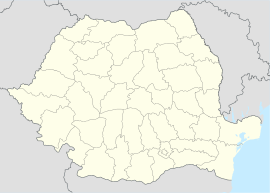  Dăbâca Location in Romania | |
| Coordinates: 46°58′21″N 23°40′28″E | |
| Country | Romania |
| County | Cluj |
| Established | 1068 |
| Subdivisions | Dăbâca, Luna de Jos, Pâglișa |
| Government | |
| • Mayor (2020–2024) | Emil Cioban[1] (PNL) |
| Area | 50 km2 (20 sq mi) |
| Elevation | 334 m (1,096 ft) |
| Highest elevation | 698 m (2,290 ft) |
| Population (2011)[2] | 1,543 |
| • Density | 31/km2 (80/sq mi) |
| Time zone | EET/EEST (UTC+2/+3) |
| Postal code | 407265 |
| Area code | +40 x64 |
| Vehicle reg. | CJ |
| Website | primaria-dabaca |
Geography
The commune lies on the banks of the river Lonea. It is located in the central-north part of the county, at a distance of 24 km (15 mi) from Gherla and 37 km (23 mi) from the county seat, Cluj-Napoca. Dăbâca borders the following communes: Panticeu to the north, Cornești and Iclod to the east, Borșa and Bonțida to the south, and Vultureni to the west.
The ruins of Dăbâca Fortress lie on Fortress Hill, at an altitude of 698 m (2,290 ft); the fortress once was the seat of Doboka County.
Demographics
According to the census from 2002 there was a total population of 1,804 people living in this commune. Of this population, 87.91% are ethnic Romanians, 7.53% are ethnic Hungarians, and 4.43% ethnic Romani.[3]
References
- "Results of the 2020 local elections". Central Electoral Bureau. Retrieved 11 June 2021.
- "Populaţia stabilă pe judeţe, municipii, oraşe şi localităti componenete la RPL_2011" (XLS). National Institute of Statistics.
- "Structura Etno-demografică a României". Archived from the original on 2012-04-26. Retrieved 2011-08-18.
External links
- Pintilie, Mariana; Pintilie, Dorin (2001). Comuna Dăbâca: studiu monografic (in Romanian). Cluj-Napoca: Eurodidact. ISBN 9738509246. OCLC 895718643.


Cluj County, Romania | ||
|---|---|---|
| Cities |
|  |
| Towns | ||
| Communes |
| |
| Authority control |
|
|---|

 | This Cluj County location article is a stub. You can help Wikipedia by expanding it. |
На других языках
[de] Dăbâca (Cluj)
Dăbâca oder Dăbîca (deutsch (alt) Dobeschdorf, ungarisch Doboka) ist eine Gemeinde im Kreis Cluj in der Region Siebenbürgen in Rumänien.- [en] Dăbâca
Текст в блоке "Читать" взят с сайта "Википедия" и доступен по лицензии Creative Commons Attribution-ShareAlike; в отдельных случаях могут действовать дополнительные условия.
Другой контент может иметь иную лицензию. Перед использованием материалов сайта WikiSort.org внимательно изучите правила лицензирования конкретных элементов наполнения сайта.
Другой контент может иметь иную лицензию. Перед использованием материалов сайта WikiSort.org внимательно изучите правила лицензирования конкретных элементов наполнения сайта.
2019-2026
WikiSort.org - проект по пересортировке и дополнению контента Википедии
WikiSort.org - проект по пересортировке и дополнению контента Википедии