world.wikisort.org - Philippines
Inabanga, officially the Municipality of Inabanga (Cebuano: Munisipyo sa Inabanga; Tagalog: Bayan ng Inabanga), is a 3rd class municipality in the province of Bohol, Philippines. According to the 2020 census, it has a population of 48,534 people. [3]
Inabanga | |
|---|---|
Municipality | |
| Municipality of Inabanga | |
 Inabanga main street | |
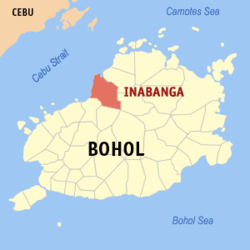 Map of Bohol with Inabanga highlighted | |
OpenStreetMap  | |
  Inabanga Location within the Philippines | |
| Coordinates: 10°02′N 124°04′E | |
| Country | Philippines |
| Region | Central Visayas |
| Province | Bohol |
| District | 2nd district |
| Barangays | 50 (see Barangays) |
| Government | |
| • Type | Sangguniang Bayan |
| • Mayor | Josephine Socorro C. Jumamoy |
| • Vice Mayor | Rodrigo U. Jumamoy |
| • Representative | Erico Aristotle C. Aumentado |
| • Municipal Council | Members |
| • Electorate | 29,799 voters (2019) |
| Area | |
| • Total | 125.63 km2 (48.51 sq mi) |
| Elevation | 9.0 m (29.5 ft) |
| Highest elevation | 141 m (463 ft) |
| Lowest elevation | −3 m (−10 ft) |
| Population | |
| • Total | 48,534 |
| • Density | 390/km2 (1,000/sq mi) |
| • Households | 7,485 |
| Economy | |
| • Income class | 3rd municipal income class |
| • Poverty incidence | 25.40% (2018)[4] |
| • Revenue | ₱168,301,256.82 (2020) |
| • Assets | ₱699,606,128.57 (2020) |
| • Expenditure | ₱155,481,466.85 (2020) |
| • Liabilities | ₱171,991,931.46 (2020) |
| Service provider | |
| • Electricity | Bohol 1 Electric Cooperative (BOHECO 1) |
| Time zone | UTC+8 (PST) |
| ZIP code | 6332 |
| PSGC | |
| IDD : area code | +63 (0)38 |
| Native languages | Boholano dialect Cebuano Eskayan Tagalog |
| Website | www |
The town of Inabanga, Bohol celebrates its fiesta on 29 and 30 June, to honor the town patron, Saint Paul.[5]
Inabanga was the site of the 2017 Bohol clashes between Philippine security forces and Moro ISIL-affiliated militants led by members of the Abu Sayyaf.
Geography
The municipality is located at the mouth of the Inabanga River, the largest river in Bohol.[6]
Land use:[7]
- Timberland area: 5,305 ha (13,110 acres)
- Mangrove area: 767 ha (1,900 acres)
- Alienable & Disposable (A & D): None
Soil cover:[7]
- Bantog clay
- Inabanga clay
- Bolinao clay
- Annam clay
- Hydrosol
Barangays

Inabanga comprises 50 barangays:
| PSGC | Barangay | Population | ±% p.a. | |||
|---|---|---|---|---|---|---|
| 2020 [3] | 2010 [8] | |||||
| 071224001 | Anonang | 1.5% | 748 | 721 | 0.35% | |
| 071224002 | Bahan | 1.3% | 651 | 464 | 3.30% | |
| 071224003 | Badiang | 2.2% | 1,085 | 1,083 | 0.02% | |
| 071224005 | Baguhan | 1.0% | 501 | 541 | −0.73% | |
| 071224007 | Banahao | 1.6% | 760 | 652 | 1.48% | |
| 071224008 | Baogo | 2.5% | 1,226 | 1,252 | −0.20% | |
| 071224009 | Bugang | 1.7% | 810 | 696 | 1.46% | |
| 071224010 | Cagawasan | 3.0% | 1,452 | 1,290 | 1.14% | |
| 071224011 | Cagayan | 0.9% | 429 | 390 | 0.92% | |
| 071224012 | Cambitoon | 2.3% | 1,132 | 919 | 2.02% | |
| 071224013 | Canlinte | 0.6% | 276 | 276 | 0.00% | |
| 071224014 | Cawayan | 2.0% | 969 | 1,147 | −1.60% | |
| 071224015 | Cogon | 1.7% | 820 | 865 | −0.51% | |
| 071224016 | Cuaming | 6.1% | 2,951 | 2,826 | 0.42% | |
| 071224017 | Dagnawan | 1.3% | 630 | 637 | −0.11% | |
| 071224018 | Dagohoy | 3.2% | 1,540 | 1,310 | 1.56% | |
| 071224019 | Dait Sur | 1.6% | 778 | 622 | 2.17% | |
| 071224020 | Datag | 1.4% | 661 | 559 | 1.62% | |
| 071224021 | Fatima | 1.8% | 861 | 721 | 1.71% | |
| 071224022 | Hambongan | 1.4% | 666 | 523 | 2.34% | |
| 071224023 | Ilaud (Poblacion) | 1.8% | 861 | 954 | −0.98% | |
| 071224024 | Ilaya | 0.9% | 414 | 376 | 0.93% | |
| 071224025 | Ilihan | 0.9% | 414 | 398 | 0.38% | |
| 071224027 | Lapacan Norte | 0.8% | 396 | 350 | 1.19% | |
| 071224028 | Lapacan Sur | 2.4% | 1,187 | 1,217 | −0.24% | |
| 071224029 | Lawis | 2.7% | 1,297 | 1,389 | −0.65% | |
| 071224030 | Liloan Norte | 3.1% | 1,492 | 1,490 | 0.01% | |
| 071224031 | Liloan Sur | 2.4% | 1,165 | 954 | 1.93% | |
| 071224032 | Lomboy | 1.2% | 591 | 589 | 0.03% | |
| 071224033 | Lonoy Cainsican | 1.4% | 696 | 656 | 0.57% | |
| 071224034 | Lonoy Roma | 1.2% | 581 | 593 | −0.20% | |
| 071224035 | Lutao | 2.5% | 1,199 | 1,173 | 0.21% | |
| 071224036 | Luyo | 1.7% | 822 | 732 | 1.12% | |
| 071224037 | Mabuhay | 0.9% | 449 | 383 | 1.53% | |
| 071224038 | Maria Rosario | 1.6% | 764 | 424 | 5.80% | |
| 071224039 | Nabuad | 4.1% | 1,998 | 1,804 | 0.98% | |
| 071224040 | Napo | 1.5% | 728 | 706 | 0.29% | |
| 071224041 | Ondol | 2.3% | 1,107 | 1,122 | −0.13% | |
| 071224042 | Poblacion | 2.0% | 966 | 930 | 0.36% | |
| 071224043 | Riverside | 0.5% | 260 | 260 | 0.00% | |
| 071224044 | Saa | 1.3% | 619 | 634 | −0.23% | |
| 071224045 | San Isidro | 1.7% | 844 | 992 | −1.54% | |
| 071224046 | San Jose | 4.4% | 2,116 | 1,566 | 2.93% | |
| 071224047 | Santo Niño | 1.4% | 686 | 799 | −1.45% | |
| 071224048 | Santo Rosario | 2.3% | 1,117 | 997 | 1.09% | |
| 071224049 | Sua | 1.5% | 709 | 554 | 2.39% | |
| 071224050 | Tambook | 1.0% | 464 | 490 | −0.52% | |
| 071224051 | Tungod | 2.4% | 1,184 | 1,089 | 0.80% | |
| 071224052 | U‑og | 2.0% | 957 | 1,112 | −1.43% | |
| 071224053 | Ubujan | 2.3% | 1,111 | 1,064 | 0.41% | |
| Total | 48,534 | 43,291 | 1.10% | |||
Climate
| Climate data for Inabanga, Bohol | |||||||||||||
|---|---|---|---|---|---|---|---|---|---|---|---|---|---|
| Month | Jan | Feb | Mar | Apr | May | Jun | Jul | Aug | Sep | Oct | Nov | Dec | Year |
| Average high °C (°F) | 28 (82) |
28 (82) |
29 (84) |
31 (88) |
31 (88) |
30 (86) |
30 (86) |
30 (86) |
30 (86) |
29 (84) |
29 (84) |
28 (82) |
29 (85) |
| Average low °C (°F) | 23 (73) |
23 (73) |
23 (73) |
23 (73) |
24 (75) |
24 (75) |
24 (75) |
24 (75) |
24 (75) |
24 (75) |
24 (75) |
23 (73) |
24 (74) |
| Average precipitation mm (inches) | 98 (3.9) |
82 (3.2) |
96 (3.8) |
71 (2.8) |
104 (4.1) |
129 (5.1) |
101 (4.0) |
94 (3.7) |
99 (3.9) |
135 (5.3) |
174 (6.9) |
143 (5.6) |
1,326 (52.3) |
| Average rainy days | 18.0 | 14.1 | 17.1 | 16.8 | 23.7 | 25.7 | 25.8 | 23.3 | 24.2 | 25.9 | 24.0 | 20.6 | 259.2 |
| Source: Meteoblue (modeled/calculated data, not measured locally)[9] | |||||||||||||
Demographics

| Year | Pop. | ±% p.a. |
|---|---|---|
| 1903 | 13,123 | — |
| 1918 | 14,210 | +0.53% |
| 1939 | 15,371 | +0.37% |
| 1948 | 16,239 | +0.61% |
| 1960 | 16,732 | +0.25% |
| 1970 | 19,618 | +1.60% |
| 1975 | 21,895 | +2.23% |
| 1980 | 23,494 | +1.42% |
| 1990 | 26,163 | +1.08% |
| 1995 | 29,354 | +2.18% |
| 2000 | 30,643 | +0.93% |
| 2007 | 32,034 | +0.61% |
| 2010 | 43,291 | +11.58% |
| 2015 | 45,880 | +1.11% |
| 2020 | 48,534 | +1.11% |
| Source: Philippine Statistics Authority [10] [8] [11][12] | ||
Predominant religion: Roman Catholic.
Economy

Annual Income (2016): ₱114.0 million
Major industries:[7]
- farming
- fishing
- mat-weaving
- nipa thatch-making
Tourism

The North Bohol fault, which appeared during the 2013 Bohol earthquake, became a tourist attraction in Bohol province.[20]
Infrastructure

Transportation
Total road length:[7] 130.6 kilometres (81 mi)
Total number of bridges: 8
Utilities
Water supply:[7]
- Main source of potable water: Groundwater
- L1 facilities – 489 water wells
- L2 systems in brgy Pob.
- L3 systems serving 22 barangays
- Potable water demand (1998): 73,230 cubic metres (19,000,000 US gal; 59 acre⋅ft) per day
Energization status (2010):[7]
- 50 barangays energized
- 8,710 actual household connections (98%)
- 8,900 potential house connections
Number of households with access to sanitary toilets: 7,686 (86%)
Welfare
- Number of Barangay Health Stations: 28
- Number of Hospitals: 1
- Number of Municipal Health Centers: 1
- Number of Day Care Centers: 50
Education
Literacy rate: 92%
Secondary and high schools:[21][22]
|
|
Elementary and primary schools:[23]
|
|
Notable personalities
- Francisco Dagohoy - Filipino revolutionary leading the longest revolt in the Philippines
- Yamyam Gucong - Pinoy Big Brother Otso Big Winner
References
- Municipality of Inabanga | (DILG)
- "2015 Census of Population, Report No. 3 – Population, Land Area, and Population Density" (PDF). Philippine Statistics Authority. Quezon City, Philippines. August 2016. ISSN 0117-1453. Archived (PDF) from the original on May 25, 2021. Retrieved July 16, 2021.
- Census of Population (2020). "Region VII (Central Visayas)". Total Population by Province, City, Municipality and Barangay. PSA. Retrieved 8 July 2021.
- "PSA Releases the 2018 Municipal and City Level Poverty Estimates". Philippine Statistics Authority. 15 December 2021. Retrieved 22 January 2022.
- "Bohol Festivals Timetable". www.bohol-philippines.com. Retrieved 2019-03-06.
- Villegas, Ramon N., ed. (2003). Tubod : the heart of Bohol. Manila: National Commission for Culture and the Arts. ISBN 9718140360.
- "Municipality of Inabanga". www.bohol.gov.ph. Official website of the Province of Bohol. Retrieved 19 December 2014.
- Census of Population and Housing (2010). "Region VII (Central Visayas)". Total Population by Province, City, Municipality and Barangay. NSO. Retrieved 29 June 2016.
- "Inabanga: Average Temperatures and Rainfall". Meteoblue. Retrieved 9 May 2020.
- Census of Population (2015). "Region VII (Central Visayas)". Total Population by Province, City, Municipality and Barangay. PSA. Retrieved 20 June 2016.
- Censuses of Population (1903–2007). "Region VII (Central Visayas)". Table 1. Population Enumerated in Various Censuses by Province/Highly Urbanized City: 1903 to 2007. NSO.
- "Province of Bohol". Municipality Population Data. Local Water Utilities Administration Research Division. Retrieved 17 December 2016.
- "Poverty incidence (PI):". Philippine Statistics Authority. Retrieved 28 December 2020.
- https://psa.gov.ph/sites/default/files/NSCB_LocalPovertyPhilippines_0.pdf; publication date: 29 November 2005; publisher: Philippine Statistics Authority.
- https://psa.gov.ph/sites/default/files/2003%20SAE%20of%20poverty%20%28Full%20Report%29_1.pdf; publication date: 23 March 2009; publisher: Philippine Statistics Authority.
- https://psa.gov.ph/sites/default/files/2006%20and%202009%20City%20and%20Municipal%20Level%20Poverty%20Estimates_0_1.pdf; publication date: 3 August 2012; publisher: Philippine Statistics Authority.
- https://psa.gov.ph/sites/default/files/2012%20Municipal%20and%20City%20Level%20Poverty%20Estima7tes%20Publication%20%281%29.pdf; publication date: 31 May 2016; publisher: Philippine Statistics Authority.
- https://psa.gov.ph/sites/default/files/City%20and%20Municipal-level%20Small%20Area%20Poverty%20Estimates_%202009%2C%202012%20and%202015_0.xlsx; publication date: 10 July 2019; publisher: Philippine Statistics Authority.
- "PSA Releases the 2018 Municipal and City Level Poverty Estimates". Philippine Statistics Authority. 15 December 2021. Retrieved 22 January 2022.
- "Post-earthquake Bohol: Silver lining after the disaster". DENR. Archived from the original on 25 January 2017.
- "List of High Schools". DepEd - Bohol. January 1, 2015. Retrieved 5 March 2015.
- "Catholic Educational Institutions". Roman Catholic Diocese of Talibon. January 1, 2014. Archived from the original on February 4, 2015. Retrieved 5 March 2015.
- "List of Elementary Schools". DepEd – Bohol. January 1, 2015. Retrieved 5 March 2015.
External links

Places adjacent to Inabanga | ||||||||||||||||
|---|---|---|---|---|---|---|---|---|---|---|---|---|---|---|---|---|
| ||||||||||||||||


 Province of Bohol Province of Bohol | |
|---|---|
Tagbilaran (capital) | |
| Municipalities |
|
| Component city | |
| Islands | |
На других языках
[de] Inabanga
Inabanga ist eine philippinische Stadtgemeinde in der Provinz Bohol. Sie hat 45.880 Einwohner (Zensus 1. August 2015).- [en] Inabanga
Другой контент может иметь иную лицензию. Перед использованием материалов сайта WikiSort.org внимательно изучите правила лицензирования конкретных элементов наполнения сайта.
WikiSort.org - проект по пересортировке и дополнению контента Википедии