world.wikisort.org - France
Xamontarupt (French pronunciation: [ʃamɔ̃taʁy] ( listen)) is a commune in the Vosges department in Grand Est in northeastern France.
Its inhabitants are known as Rupéains[2] or Xamontois.[3]
listen)) is a commune in the Vosges department in Grand Est in northeastern France.
Its inhabitants are known as Rupéains[2] or Xamontois.[3]
 | This article may be expanded with text translated from the corresponding article in French. (September 2013) Click [show] for important translation instructions.
|
Xamontarupt | |
|---|---|
Commune | |
 Town hall | |
Location of Xamontarupt  | |
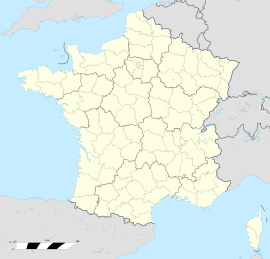  Xamontarupt  Xamontarupt | |
| Coordinates: 48°08′00″N 6°39′14″E | |
| Country | France |
| Region | Grand Est |
| Department | Vosges |
| Arrondissement | Épinal |
| Canton | Bruyères |
| Intercommunality | Bruyères-Vallons des Vosges |
| Government | |
| • Mayor (2020–2026) | Emmanuel Parisse |
| Area 1 | 5 km2 (2 sq mi) |
| Population | 156 |
| • Density | 31/km2 (81/sq mi) |
| Time zone | UTC+01:00 (CET) |
| • Summer (DST) | UTC+02:00 (CEST) |
| INSEE/Postal code | 88528 /88460 |
| Elevation | 393–671 m (1,289–2,201 ft) |
| 1 French Land Register data, which excludes lakes, ponds, glaciers > 1 km2 (0.386 sq mi or 247 acres) and river estuaries. | |
Geography
Abutting the heavily wooded massif of le Fossard, the village is crossed by the Cuves stream, an outflow of the Vologne river.
History
Evidence of protohistoric human presence: construction from set stones, flakes of cut quartz. 400-year old holly in the village, probably some of the oldest in Europe, can be seen on the route leading to the Haut-du-Bois maquis.
In 1656, the village was called "Charmontaruz"
Population
| Year | Pop. | ±% p.a. |
|---|---|---|
| 1968 | 108 | — |
| 1975 | 95 | −1.82% |
| 1982 | 82 | −2.08% |
| 1990 | 140 | +6.92% |
| 1999 | 138 | −0.16% |
| 2007 | 152 | +1.22% |
| 2012 | 149 | −0.40% |
| 2017 | 155 | +0.79% |
| Source: INSEE[4] | ||
Personalities
- Jean-René Claudel, amateur speleologist and archeologist, discovered the flakes of quartzite[5] · .[6]
See also
References
- "Populations légales 2019". The National Institute of Statistics and Economic Studies. 29 December 2021.
- habitants.fr website
- Communauté de communes website
- Population en historique depuis 1968, INSEE
- www.persee.fr : Note préliminaire sur quelques stations lorraines à quartzites paléolithiques.
- "www.vosges-archives.com" (PDF). Archived from the original (PDF) on 2012-04-02. (85.4 KB) : Fonds Jean-René Claudel,Vice-Président du Groupe spéléo-préhistorique vosgien (1935-1976).
External links

Wikimedia Commons has media related to Xamontarupt.


 | This Vosges geographical article is a stub. You can help Wikipedia by expanding it. |
На других языках
- [en] Xamontarupt
[es] Xamontarupt
Xamontarupt es una población y comuna francesa, en la región de Lorena, departamento de Vosgos, en el distrito de Épinal y cantón de Bruyères.Текст в блоке "Читать" взят с сайта "Википедия" и доступен по лицензии Creative Commons Attribution-ShareAlike; в отдельных случаях могут действовать дополнительные условия.
Другой контент может иметь иную лицензию. Перед использованием материалов сайта WikiSort.org внимательно изучите правила лицензирования конкретных элементов наполнения сайта.
Другой контент может иметь иную лицензию. Перед использованием материалов сайта WikiSort.org внимательно изучите правила лицензирования конкретных элементов наполнения сайта.
2019-2026
WikiSort.org - проект по пересортировке и дополнению контента Википедии
WikiSort.org - проект по пересортировке и дополнению контента Википедии