world.wikisort.org - France
Stenay (French pronunciation: [stənɛ]) is a commune in the Meuse department in Grand Est in north-eastern France.
 | This article may be expanded with text translated from the corresponding article in French. (August 2019) Click [show] for important translation instructions.
|
Stenay | |
|---|---|
Commune | |
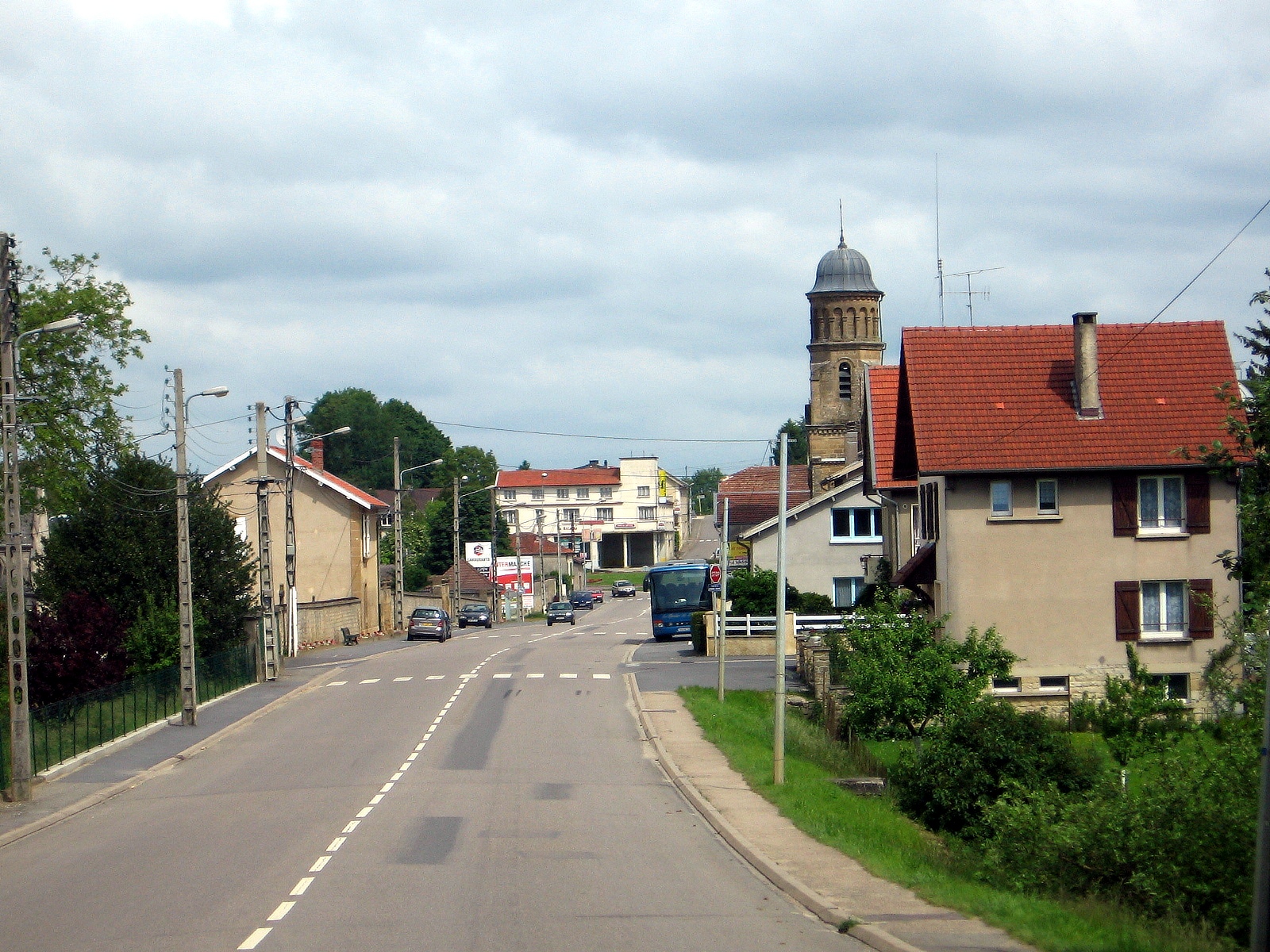 A general view of Stenay | |
 Coat of arms | |
Location of Stenay  | |
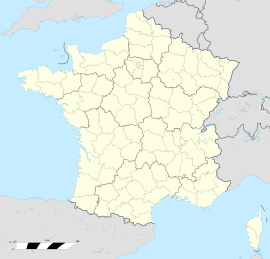  Stenay  Stenay | |
| Coordinates: 49°29′27″N 5°11′11″E | |
| Country | France |
| Region | Grand Est |
| Department | Meuse |
| Arrondissement | Verdun |
| Canton | Stenay |
| Government | |
| • Mayor (2020–2026) | Stéphane Perrin[1] |
| Area 1 | 27.16 km2 (10.49 sq mi) |
| Population | 2,507 |
| • Density | 92/km2 (240/sq mi) |
| Time zone | UTC+01:00 (CET) |
| • Summer (DST) | UTC+02:00 (CEST) |
| INSEE/Postal code | 55502 /55700 |
| Elevation | 163–303 m (535–994 ft) |
| 1 French Land Register data, which excludes lakes, ponds, glaciers > 1 km2 (0.386 sq mi or 247 acres) and river estuaries. | |
Its inhabitants are called Stenaisiens.[3]
History

In 679, the assassinated king Dagobert II was buried in the church of Saint-Remi in Stenay. In 872, King Charles the Bald had his body moved a newly built basilica dedicated to him. In 1069, the canons of the basilica were accused of laxness. Duke Godfrey the Bearded handed the basilica over to Gorze Abbey and it became a Benedictine priory. The Vita Dagoberti was written there. In 1580, the basilica was secularized and the cloisters demolished. In 1591, what remained was sacked by Huguenots.[4]
Stenay was one of the last villages to experience fighting during the First World War.[5] The village was captured on 11 November 1918 by the U.S. 89th Division, commanded by Major General William M. Wright, only hours before the Armistice with Germany went into effect. The 89th Division lost 365 men, mainly to enemy howitzer fire.[6]
Toponymy
According to local tradition in antiquity, the village is named after a local temple of Saturn. The name has changed significantly over time, starting with Sathanagium and Astenidum, and, through natural language change, resulting in Stenay.
The progression of names is as follows:[7][8]
- Sathanagium, Sathonagium (714)
- Astenidum (877)
- Astanid (888)
- Satenaium (900s)
- Sathaniacum (900s)
- Sathinidium (1036)
- Sathanacum (1069)
- Setunia (1000s)
- Sathanacum villam (1079)
- Satiniacum, Sathiniacum (1086)
- Sathanaco (1108)
- Sathanacensi (1157)
- Sathaniaco (1159)
- Sathanai (1173)
- Sethenac (1208)
- Settenai (1243)
- Sethenai (1264)
- Sathenay (1276, 1399, 1463, 1483, 1549, 1558, 1585)
- Sathanay (1284)
- Satenay (1399)
- Astenæum (1580)
- Satanagus (1630)
- Satanay, Sthenay (1643)
- Stenay (1793).
Tourism
The European Beer Museum (Musée Européen de la bière), founded in 1986, is considered the largest of its kind on the continent.[9][10][11]
See also
References
- "Répertoire national des élus: les maires". data.gouv.fr, Plateforme ouverte des données publiques françaises (in French). 2 December 2020.
- "Populations légales 2019". The National Institute of Statistics and Economic Studies. 29 December 2021.
- Gentilé on the web site www.habitants.fr. Accessed 5 January 2016.
- Paul J. Fouracre (2008), "Forgetting and Remembering Dagobert II: The English Connection", Frankland: The Franks and the World of the Early Middle Ages, Manchester: Manchester University Press, pp. 70–89.
- John Hayes-Fisher , "The last soldiers to die in World War I", BBC News Magazine, 29 October 2008
- Joseph E. Persico. Wright's stated reason for the attack was because "the division had been in the line a considerable period without proper bathing facilities, and since it was realized that if the enemy were permitted to stay in Stenay, our troops would be deprived of the probable bathing facilities there." World War I: Wasted Lives on Armistice Day. History Net.
- Félix Liénard, Topographical Dictionary of the Meuse Department , 1872.
- Des villages de Cassini aux communes d'aujourd'hui: Commune data sheet Stenay, EHESS. (in French)
- "Musée de la bière". Retrieved 2018-08-31.
- "Meuse tourism". Retrieved 2018-08-31.
- "Meuse tourism". Retrieved 2018-08-31.
External links

- Stenay tourist office
- Stenay and the Myth
- Moulin le Cygne the Myth of Satan [ web.archive.org] History of the town
Authority control | |
|---|---|
| General |
|
| National libraries | |

 | This Meuse geographical article is a stub. You can help Wikipedia by expanding it. |
На других языках
- [en] Stenay
[es] Stenay
Stenay es una población y comuna francesa, en la región de Lorena, departamento de Mosa, en el Distrito de Verdún y cantón de Stenay.[ru] Стене
Стене (фр. Stenay) — французская коммуна в департаменте Мёз в регионе Гранд-Эст, с населением 2520 человек (2018). Жители города именуются стенезийцами (les Stenaisiens).Другой контент может иметь иную лицензию. Перед использованием материалов сайта WikiSort.org внимательно изучите правила лицензирования конкретных элементов наполнения сайта.
WikiSort.org - проект по пересортировке и дополнению контента Википедии