world.wikisort.org - Canada
Sainte-Marie is a city in the province of Quebec, Canada. It is the seat of the Municipalité régionale de la Nouvelle-Beauce, in Chaudière-Appalaches. The population was 13,134 as of the Canada 2021 Census, and was 95.7% French-speaking as of 2021. It is located 59 kilometres (37 mi) south-east of Quebec City, on the Chaudière River.
Sainte-Marie | |
|---|---|
City | |
 Taschereau Mansion and Sainte-Anne Chapel | |
 Seal | |
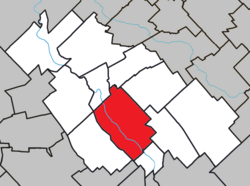 Location within La Nouvelle-Beauce RCM | |
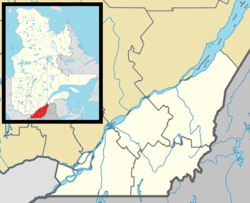  Sainte-Marie Location in southern Quebec | |
| Coordinates: 46°27′N 71°02′W[1] | |
| Country | Canada |
| Province | Quebec |
| Region | Chaudière-Appalaches |
| RCM | La Nouvelle-Beauce |
| Constituted | April 15, 1978 |
| Government | |
| • Mayor | Guetan Vachon |
| • Federal riding | Beauce |
| • Prov. riding | Beauce-Nord |
| Area | |
| • Total | 108.90 km2 (42.05 sq mi) |
| • Land | 107.55 km2 (41.53 sq mi) |
| Population (2021)[3] | |
| • Total | 13,134 |
| • Density | 122.1/km2 (316/sq mi) |
| • Pop 2016-2021 |  3.2% 3.2% |
| • Dwellings | 5,630 |
| Demonym(s) | Mariverains, Mariveraines |
| Time zone | UTC−5 (EST) |
| • Summer (DST) | UTC−4 (EDT) |
| Postal code(s) | G6E |
| Area code(s) | 418 and 581 |
Highways  A-73 A-73 |  Route 173 Route 173  Route 216 Route 216 |
| Website | www |

History
The seigneurie of Sainte-Marie-de-la-Nouvelle-Beauce was granted to Thomas-Jacques Taschereau in 1736. He chose the name in honour of his wife, Marie-Claire de Fleury de La Gorgendière. The religious parish was founded in 1737 and the municipality in 1845.
The territory of Sainte-Marie was divided on several occasions, as population increased, in order to found neighbouring communities: Saint-Bernard, Saint-Isidore, Saint-Maxime-de-Scott (now Scott), Sainte-Marguerite, Sainte-Hénédine, Saint-Sylvestre, Saint-Elzéar, Saint-Séverin, Saints-Anges, and Vallée-Jonction.
In 1913, the territory was split again, following the detachment of the village (urban part of the territory) from the parish municipality (rural part). In 1958, the village was constituted as a city and in 1959, Sainte-Marie-de-la-Nouvelle-Beauce was renamed as Sainte-Marie. In 1978, the city and the parish municipality governments amalgamated.
Demographics
| Year | Pop. | ±% |
|---|---|---|
| 1921 | 1,311 | — |
| 1931 | 1,598 | +21.9% |
| 1941 | 1,736 | +8.6% |
| 1951 | 2,431 | +40.0% |
| 1956 | 3,094 | +27.3% |
| 1961 | 3,662 | +18.4% |
| 1966 | 4,192 | +14.5% |
| 1971 | 4,307 | +2.7% |
| 1976 | 4,462 | +3.6% |
| 1981* | 8,936 | +100.3% |
| 1986 | 9,536 | +6.7% |
| 1991 | 10,542 | +10.5% |
| 1996 | 10,966 | +4.0% |
| 2001 | 11,320 | +3.2% |
| 2006 | 11,584 | +2.3% |
| 2011 | 12,889 | +11.3% |
| 2016 | 13,565 | +5.2% |
| 2021 | 13,134 | −3.2% |
(*) The Town of Sainte-Marie annexed the Parish of Sainte-Marie. Source: Statistics Canada | ||
In the 2021 Census of Population conducted by Statistics Canada, Sainte-Marie had a population of 13,134 living in 5,500 of its 5,630 total private dwellings, a change of -3.2% from its 2016 population of 13,565. With a land area of 107.55 km2 (41.53 sq mi), it had a population density of 122.1/km2 (316.3/sq mi) in 2021.[4]
Notable people
- Marius Barbeau, ethnographer
- Elzéar-Henri Juchereau Duchesnay, Canadian politician
- Ernest Savard, hockey executive, head coach, general manager (Montreal Canadiens)
- Nycole Turmel, Canadian politician
- Henri-Jules Juchereau Duchesnay, Canadian politician
- Gabriel-Elzéar Taschereau, Quebec politician
- Elzéar-Alexandre Taschereau, clergyman
- Henri Elzéar Taschereau, lawyer
- Jean-Thomas Taschereau, lawyer
- Joseph-André Taschereau, judge
- Pierre-Elzéar Taschereau, Canadian politician
- Thomas Linière Taschereau, Canadian politician
- Mario Gosselin, NASCAR driver
- Thomas Chabot, ice hockey defenceman for the NHL’s Ottawa Senators
Partner cities
 Pont-du-Château, Auvergne, France

References
- "Reference number 56297 in Banque de noms de lieux du Québec". toponymie.gouv.qc.ca (in French). Commission de toponymie du Québec.
- "Geographic code 26030 in the official Répertoire des municipalités". www.mamh.gouv.qc.ca (in French). Ministère des Affaires municipales et de l'Habitation.
- "Census Profile, 2021 Census, Statistics Canada - Validation Error".
- "Population and dwelling counts: Canada, provinces and territories, and census subdivisions (municipalities), Quebec". Statistics Canada. February 9, 2022. Retrieved August 29, 2022.
External links
 Media related to Sainte-Marie, Quebec at Wikimedia Commons
- Official website

- Commission de toponymie du Québec
- Ministère des Affaires municipales, des Régions et de l'Occupation du territoire

Places adjacent to Sainte-Marie, Quebec | ||||||||||||||||
|---|---|---|---|---|---|---|---|---|---|---|---|---|---|---|---|---|
| ||||||||||||||||


| Cities & Towns | |
|---|---|
| Municipalities |
|
| Parishes |
|
| |

Authority control | |
|---|---|
| General | |
| National libraries | |
На других языках
[de] Sainte-Marie (Québec)
Sainte-Marie ist eine Stadt (ville) und Hauptort der MRC La Nouvelle-Beauce in der kanadischen Provinz Québec.- [en] Sainte-Marie, Quebec
Другой контент может иметь иную лицензию. Перед использованием материалов сайта WikiSort.org внимательно изучите правила лицензирования конкретных элементов наполнения сайта.
WikiSort.org - проект по пересортировке и дополнению контента Википедии