world.wikisort.org - Canada
North Red Deer is a former village in central Alberta, Canada within the City of Red Deer.[2]
North Red Deer | |
|---|---|
Former village | |
  North Red Deer Location of North Red Deer 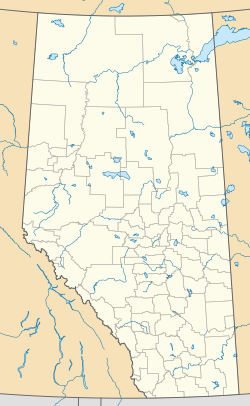 North Red Deer North Red Deer (Alberta) | |
| Coordinates: 52°16′48″N 113°49′23″W | |
| Country | Canada |
| Province | Alberta |
| Region | Central Alberta |
| Census division | No. 8 |
| City | Red Deer County |
| Founded[1] | 1894 |
| Incorporated (village)[1] | February 17, 1911 |
| Amalgamated[1] | January 1, 1948 |
| Time zone | UTC-7 (MST) |
| • Summer (DST) | UTC-6 (MDT) |
| Area codes | 403 / 587 |
| Waterways | Red Deer River |
The village was on the north shore of the Red Deer River along the Calgary and Edmonton (C&E) Railway,[3] which was later acquired by the Canadian Pacific Railway. The former village is located within Red Deer's Riverside Meadows neighbourhood,[2][4] with portions also being located within the neighbourhoods of Highland Green and Oriole Park.
History
North Red Deer was established as a hamlet in 1894 upon completion of the C&E rail line, including the bridge over the Red Deer River.[1] It incorporated as the Village of North Red Deer on February 17, 1911,[1] with the ministerial order being signed on June 18, 1911.[2] Walter Webb became the village's first mayor on March 13, 1911.[5]
After a previously unratified attempt in 1946,[5] the Village of North Red Deer amalgamated with the City of Red Deer on January 1, 1948.[2][1] The last village council meeting occurred on December 24, 1947.[2][6]
In 1999, the City of Red Deer renamed the area of the former village to Riverside Meadows.[6] In 2000, the city adopted the Riverside Meadows Area Redevelopment Plan (ARP),[7] which was replaced by a new ARP in 2009.[8] The City of Red Deer celebrated the centennial of the Village of North Red Deer on August 27, 2011.[2]
Demographics
Over the course of its incorporation, North Red Deer grew from a population of 304 in 1911[10] to a population of 698 in 1946.[11]
See also
- List of communities in Alberta
- List of former urban municipalities in Alberta
References
- "North Red Deer: A Century of Change". City of Red Deer. 2011. Archived from the original on 2011-09-28. Retrieved 2011-07-24.
- "2011 Village of North Red Deer Centennial Celebrations". City of Red Deer. 2011. Archived from the original on 2011-06-23. Retrieved 2011-07-24.
- Village of North Red Deer 2011 Centennial Committee. "North Red Deer: A Century of Change" (PDF). City of Red Deer. p. 4. Retrieved 2011-07-24.
- "North Red Deer Community Heritage Projects". City of Red Deer. 2011. Retrieved 2011-07-24.
- Michael Dawe (2011-02-16). "Village of North Red Deer marks 100-year anniversary". Red Deer Express. Retrieved 2011-07-24.
- Michael Dawe (2002-12-18). "The Village of North Red Deer" (PDF). Red Deer Express/City of Red Deer. Retrieved 2011-07-24.
- "Edmonton Real Estate: North Red Deer Centennial". Realtor Network. 2011-02-15. Retrieved 2011-07-24.
- "Riverside Meadows Area Redevelopment Plan (Bylaw 3261/A-2009)" (PDF). City of Red Deer. 2009. Retrieved 2011-07-24.
- "Census of the Prairie Provinces, 1916" (PDF). Ottawa: Dominion Bureau of Statistics. 1918. Retrieved August 9, 2022.
- Census of the Prairie Provinces, 1936. Vol. I: Population and Agriculture. Ottawa: Dominion Bureau of Statistics. 1938. p. 835.
- Census of the Prairie Provinces, 1946. Vol. I: Population. Ottawa: Dominion Bureau of Statistics. 1949-08-22. p. 399.
External links
 | This Central Alberta location article is a stub. You can help Wikipedia by expanding it. |
Другой контент может иметь иную лицензию. Перед использованием материалов сайта WikiSort.org внимательно изучите правила лицензирования конкретных элементов наполнения сайта.
WikiSort.org - проект по пересортировке и дополнению контента Википедии