world.wikisort.org - Canada
Kiamika is a municipality in the Laurentides region of Quebec, Canada, part of the Antoine-Labelle Regional County Municipality.
Kiamika | |
|---|---|
Municipality | |
 | |
| Motto: Quel coup de cœur! | |
 Location within Antoine-Labelle RCM | |
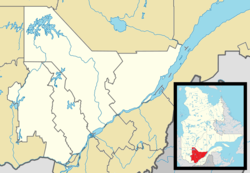  Kiamika Location in central Quebec | |
| Coordinates: 46°25′N 75°23′W[1] | |
| Country | Canada |
| Province | Quebec |
| Region | Laurentides |
| RCM | Antoine-Labelle |
| Settled | 1860s |
| Constituted | January 3, 1898 |
| Government | |
| • Mayor | Michel Dion |
| • Federal riding | Laurentides—Labelle |
| • Prov. riding | Labelle |
| Area | |
| • Total | 362.94 km2 (140.13 sq mi) |
| • Land | 337.53 km2 (130.32 sq mi) |
| Population (2021)[3] | |
| • Total | 790 |
| • Density | 2.3/km2 (6/sq mi) |
| • Pop. 2016-2021 |  4.4% 4.4% |
| • Dwellings | 508 |
| Time zone | UTC−5 (EST) |
| • Summer (DST) | UTC−4 (EDT) |
| Postal code(s) | J0W 1G0 |
| Area code | 819 |
| Highways |  Route 311 Route 311 |
| Website | www |

Joseph Montferrand (1802-1864), a logger of imposing stature and extraordinary physical strength, was from Kiamika.[1]
Etymology
The municipality is named after the Kiamika River, which flows through its territory and is a tributary of the Lièvre River. This name, mentioned by Stanislas Drapeau as Kiamica and appearing on a map of Quebec by Eugène Taché from 1870, comes from the Algonquin word kickiamika meaning "steep cut below the water", from kicki (steep cut) and amick (below the water).[1]
However, an alternate meaning may be "deep and quiet river", from the roots kiam (deep) and ka (quiet).[1][4]
History
In 1883, the Colonization Society of Montarville was founded and took possession of the area in 1884. On the banks of the Lièvre River, about 11 kilometres (6.8 mi) south of Val-Barrette, settlers established the mission of Saint-Gérard-de-Kiamika, also called Saint-Gérard-de-Montarville. A year later its post office opened. In 1890, the Kiamika Township was proclaimed.[1]
In 1898, the Township Municipality of Kiamika was formed. In 1920, the mission received its status as a parish. In 1994, the township municipality changed its statutes to become a regular municipality.[1]

Demographics
| 2021 | 2016 | |
|---|---|---|
| Population | 790 (+4.4% from 2016) | 757 (-1.9% from 2011) |
| Land area | 337.53 km2 (130.32 sq mi) | 339.92 km2 (131.24 sq mi) |
| Population density | 2.3/km2 (6.0/sq mi) | 2.2/km2 (5.7/sq mi) |
| Median age | 57.6 (M: 58.0, F: 57.2) | 53.9 (M: 54.0, F: 53.9) |
| Total private dwellings | 508 | 508 |
| Median household income | $58,800 | $51,712 |
|
| ||||||||||||||||||||||||||||||||||||
| Source: Statistics Canada | |||||||||||||||||||||||||||||||||||||
Private dwellings occupied by usual residents: 391 (total dwellings: 508)[3]
Mother tongue:[9]
- English as first language: 15
- French as first language: 750
- English and French as first language: 0
- Other as first language: 0
See also
- List of municipalities in Quebec
References
- "Kiamika (Municipalité)" (in French). Commission de toponymie du Québec. Retrieved 2009-08-21.
- "Geographic code 79025 in the official Répertoire des municipalités". www.mamh.gouv.qc.ca (in French). Ministère des Affaires municipales et de l'Habitation.
- "Kiamika, Municipalité (MÉ) Census Profile, 2021 Census of Population". www12.statcan.gc.ca. Government of Canada - Statistics Canada. Retrieved 28 June 2022.
- "Notre histoire" (in French). Municipalité de kiamika. Archived from the original on 2010-03-16. Retrieved 2009-08-21.
- "2021 Community Profiles". 2021 Canadian Census. Statistics Canada. February 4, 2022. Retrieved 2022-06-28.
- "2016 Community Profiles". 2016 Canadian Census. Statistics Canada. August 12, 2021. Retrieved 2022-06-28.
- "2006 Community Profiles". 2006 Canadian Census. Statistics Canada. August 20, 2019.
- "2001 Community Profiles". 2001 Canadian Census. Statistics Canada. July 18, 2021.
- "Statistics Canada: 2011 Census Profile". 8 February 2012.
External links
 Media related to Kiamika at Wikimedia Commons

Adjacent Municipal Subdivisions | |
|---|---|


| Cities/towns | |
|---|---|
| Municipalities | |
| Villages | |
| Unorganized territories | |
| |

| Authority control |
|
|---|
Другой контент может иметь иную лицензию. Перед использованием материалов сайта WikiSort.org внимательно изучите правила лицензирования конкретных элементов наполнения сайта.
WikiSort.org - проект по пересортировке и дополнению контента Википедии