world.wikisort.org - United_Kingdom
Broughton is a small town and civil parish situated on the Roman Ermine Street, in the North Lincolnshire district of Lincolnshire, England.[1] The population of the civil parish at the 2011 census was 5,726.[2] It is situated approximately 2 miles (3 km) north-west from the town of Brigg. The hamlets of Wressle,[3] Castlethorpe, and part of Scawby Brook lie within the parish boundaries.
 | This article needs additional citations for verification. (July 2011) |
| Broughton | |
|---|---|
  Broughton Location within Lincolnshire | |
| Population | 5,726 2011 Census |
| OS grid reference | SE963084 |
| • London | 140 mi (230 km) S |
| Unitary authority |
|
| Ceremonial county |
|
| Region |
|
| Country | England |
| Sovereign state | United Kingdom |
| Post town | BRIGG |
| Postcode district | DN20 |
| Dialling code | 01652 |
| Police | Humberside |
| Fire | Humberside |
| Ambulance | East Midlands |
| UK Parliament |
|
A settlement existed at Broughton in the Neolithic Stone Age (New Stone Age). Stone tools have been found particularly on the commons near Wressle. Pottery was discovered at a house on Ermine Street in 1956, thought to date back to the Bronze Age period. There were burials discovered around 1850 in the commons to the north-east of Broughton.
Broughton's St Mary's Church is a Grade I listed building, with a very rare Saxon staircase tower, one of four in the country. The others are at Brixworth, Brigstock and Hough-on-the-Hill.[4] The church is thought to date to the 11th century with major alterations in the 12th, 14th and 17th centuries.[5] Gokewell Priory was founded nearby in the late 12th century to house a community of nuns.
The Baronetcy of Broughton was created 11 December 1660 for Sir Edmund Anderson[citation needed] and became extinct on the death of the 9th Baron, Sir Charles Henry John Anderson,[citation needed] 8 October 1891.
To the west and north, Broughton has extensive woodlands that stretch toward Dragonby, Scunthorpe and Appleby. The south of the woods sits one of the few 4-star hotels in the area, and which has a 27-hole golf course (formerly Forest Pines, now Doubletree by Hilton - though still commonly known as Forest Pines).
Though considered by many to be a village,[5][6][7] it became a town in 1974,[8] although it still has a village hall.[1] At the 2011 Census, the size of Broughton parish was slightly larger than its neighbour Brigg, due to housing developments at the edge of the parish in Scawby Brook.
Gallery
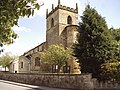 St Mary's Church
 West Broughton


References
- "Town web site". Broughton town council. Retrieved 13 April 2013.
- "Civil Parish population 2011". Neighbourhood Statistics. Office for National Statistics. Retrieved 18 April 2016.
- "Wressle, North Lincolnshire". UK Grid Reference Finder. Retrieved 23 August 2011.
- Historic England. "Church of St Mary (1161801)". National Heritage List for England. Retrieved 18 September 2018.
- St Mary's church Archived 18 February 2007 at the Wayback Machine
- Information from linc2u Archived 16 February 2006 at the Wayback Machine
- Brigglife.co.uk Archived 28 September 2006 at the Wayback Machine
- "Broughton Local History Pack". North Lincolnshire council. Archived from the original on 16 April 2013. Retrieved 13 April 2013.
External links


 Ceremonial county of Lincolnshire Ceremonial county of Lincolnshire | |
|---|---|
England Portal | |
| Unitary authorities |
|
| Boroughs or districts |
|
| Major settlements |
|
| Topics |
|
Другой контент может иметь иную лицензию. Перед использованием материалов сайта WikiSort.org внимательно изучите правила лицензирования конкретных элементов наполнения сайта.
WikiSort.org - проект по пересортировке и дополнению контента Википедии