world.wikisort.org - United_Kingdom
Sandon is a village in Staffordshire, about 4.5 miles (7 km) northeast of Stafford. The village is in the Trent Valley on the A51 road.
| Sandon | |
|---|---|
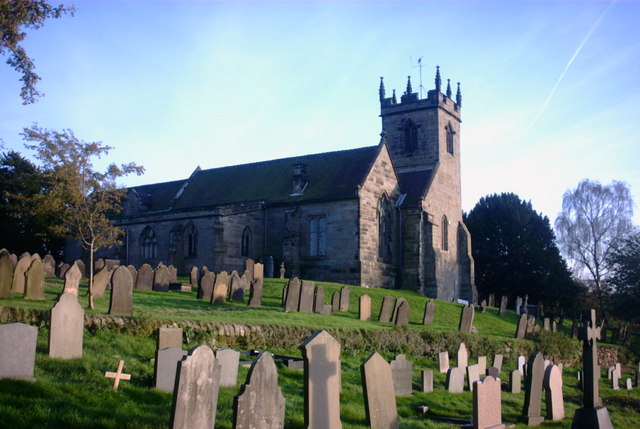 All Saints' Parish Church | |
  Sandon Location within Staffordshire | |
| Population | 361 (2011)[1] |
| OS grid reference | SJ9429 |
| Civil parish |
|
| District |
|
| Shire county |
|
| Region |
|
| Country | England |
| Sovereign state | United Kingdom |
| Post town | Stafford |
| Postcode district | ST18 |
| Dialling code | 01889 |
| Police | Staffordshire |
| Fire | Staffordshire |
| Ambulance | West Midlands |
| UK Parliament |
|
Sandon Park
There is a rectangular moated site in Sandon Park, about 186 yards (170 m) northeast of the parish church.[2] The site measures about 110 yards (100 m) by 87 yards (80 m) and the moat varies from 11 yards (10 m) to 16 yards (15 m) wide.[2] It was the site of the parish's manor house, which was the home of the Erdeswick family from 1338 until the middle of the 17th century.[2] The moat site is a scheduled monument.[2]
In 1776 Nathaniel Ryder was ennobled as Baron Harrowby. He commissioned the architect Samuel Wyatt to transform the manor house into Sandon Hall and the landscape gardener William Emes to create a 400 acres (160 ha) park.[3] Creating the park involved demolishing Sandon village, which was close to the house and parish church, and building a new village further away from the house and church.
In 1848 a workman on the roof of Sandon Hall accidentally set the building on fire, which caused such damage that it had to be demolished.[3] The current Sandon Hall is a Jacobethan country house of nine bays built for Dudley Ryder, 2nd Earl of Harrowby in 1852.[4] It was designed by the Scots Baronial architect William Burn — apart from the conservatory, which was added in 1864.[4] Sandon Hall is a Grade II* listed building.[4]
Parish church
The Church of England parish church of All Saints was built in about 1200 and almost completely rebuilt about 1300.[5] The north aisle was built in the 14th century, but was remodelled in 1851 as a family chapel for the Earls of Harrowby.[5] The church was restored in 1923 under the direction of the architect W. D. Caroe.[5] All Saints' is a Grade I listed building.[5]

Economic history
The Trent and Mersey Canal passes through the area and was completed in 1777.
The North Staffordshire Railway opened the Stone to Colwich Line through Sandon in 1849.[6] The London, Midland and Scottish Railway closed Sandon railway station in 1947 but the railway remains open as part of the West Coast Main Line.
Amenities
Sandon has a public house, the Dog and Doublet Inn,[7] that was designed by the architect Sir Guy Dawber and built in 1906.[8]
Sandon has a village shop.[9]
See also
- Listed buildings in Sandon and Burston
References
- "Civil Parish population 2011". Retrieved 11 December 2015.
- Historic England (8 November 1993). "Sandon Old Hall Moated Site (1011049)". National Heritage List for England. Retrieved 6 January 2012.
- "History". Sandon Estate. Sandon Hall. Retrieved 6 January 2012.
- Historic England (10 January 1953). "Sandon Hall, Sandon Park (1189732)". National Heritage List for England. Retrieved 6 January 2012.
- Historic England. "Church of All Saints (1294163)". National Heritage List for England. Retrieved 6 January 2012.
- Historic England. "Sandon Railway Station (1039003)". National Heritage List for England. Retrieved 6 January 2012.
- Dog and Doublet, Sandon
- Historic England (25 April 1980). "Dog and Doublet Inn (1294104)". National Heritage List for England. Retrieved 6 January 2012.
- "Sandon Village Shop". Sandon Estate. Sandon Hall. Retrieved 6 January 2012.
 |
Wikimedia Commons has media related to Sandon, Staffordshire. |
 Ceremonial county of Staffordshire Ceremonial county of Staffordshire | |
|---|---|
| Unitary authorities | Stoke-on-Trent |
| Major settlements |
|
| Rivers | |
| Canals | |
| Topics |
|
 Staffordshire portal Staffordshire portal | |
Другой контент может иметь иную лицензию. Перед использованием материалов сайта WikiSort.org внимательно изучите правила лицензирования конкретных элементов наполнения сайта.
WikiSort.org - проект по пересортировке и дополнению контента Википедии