world.wikisort.org - Sweden
Los is a locality situated in Ljusdal Municipality, Gävleborg County, Sweden with 332 inhabitants in 2020.[1]
Los | |
|---|---|
 Los seen from the site of the former Los cobalt mine. | |
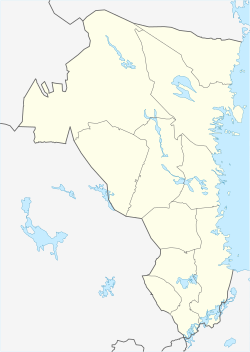  Los  Los | |
| Coordinates: 61°44′N 15°10′E | |
| Country | Sweden |
| Province | Hälsingland |
| County | Gävleborg County |
| Municipality | Ljusdal Municipality |
| Area | |
| • Total | 1.61 km2 (0.62 sq mi) |
| Population (31 December 2010)[1] | |
| • Total | 387 |
| • Density | 241/km2 (620/sq mi) |
| Time zone | UTC+1 (CET) |
| • Summer (DST) | UTC+2 (CEST) |
The village is known for its 18th-century cobalt mine, where Axel Fredrik Cronstedt discovered the chemical element of nickel in 1751. Today, the mine is a tourist attraction.
An 8-kilometre-wide crater on Mars was officially named after this village in 1979. The crater is located at 35.4°S and 76.3°W on the Martian surface.[2]
References
- "Tätorternas landareal, folkmängd och invånare per km2 2005 och 2010" (in Swedish). Statistics Sweden. 14 December 2011. Archived from the original on 27 January 2012. Retrieved 10 January 2012.
- "Mars Nomenclature: Crater, craters". Astrogeology Research Program. Retrieved 27 August 2008.
 | This article about a location in Gävleborg County, Sweden is a stub. You can help Wikipedia by expanding it. |
Текст в блоке "Читать" взят с сайта "Википедия" и доступен по лицензии Creative Commons Attribution-ShareAlike; в отдельных случаях могут действовать дополнительные условия.
Другой контент может иметь иную лицензию. Перед использованием материалов сайта WikiSort.org внимательно изучите правила лицензирования конкретных элементов наполнения сайта.
Другой контент может иметь иную лицензию. Перед использованием материалов сайта WikiSort.org внимательно изучите правила лицензирования конкретных элементов наполнения сайта.
2019-2026
WikiSort.org - проект по пересортировке и дополнению контента Википедии
WikiSort.org - проект по пересортировке и дополнению контента Википедии