world.wikisort.org - Spain
Aberásturi (Spanish pronunciation: [aβeˈɾastuɾi], Basque: Aberasturi)[2] is a hamlet and concejo located in the municipality of Vitoria-Gasteiz, in Álava province, Basque Country, Spain. It is located in the eastern part of the municipality, some 8 km (5.0 mi) from the city center, along the Ertekaberri river at the foot of a mountain and on a hillside.
Aberásturi | |
|---|---|
Concejo | |
 Church of San Esteban | |
  Aberásturi 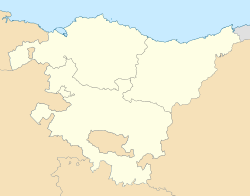 Aberásturi  Aberásturi | |
| Coordinates: 42°50′N 2°36′W | |
| Country | Spain |
| Autonomous community | Basque Country |
| Province | Álava |
| Comarca | Vitoria-Gasteiz |
| Municipality | Vitoria-Gasteiz |
| Area | |
| • Total | 10.03 km2 (3.87 sq mi) |
| Elevation | 560 m (1,840 ft) |
| Population (2021)[1] | |
| • Total | 131 |
| • Density | 13/km2 (34/sq mi) |
| Postal code | 01193 |
History
After the Cuadrilla de Añana separated from the Cuadrilla de Vitoria in 1840, Aberásturi remained within Vitoria.[3] The village had previously belonged to the now extinct municipality of Elorriaga, which was absorbed by the municipality of Vitoria around 1870.[4]
Demographics
| Year | Pop. | ±% p.a. |
|---|---|---|
| 1960 | 242 | — |
| 2000 | 121 | −1.72% |
| 2005 | 121 | +0.00% |
| 2010 | 139 | +2.81% |
| 2015 | 124 | −2.26% |
| 2020 | 130 | +0.95% |
| 2021 | 131 | +0.77% |
| Source: [1][5][6] | ||
In 1960, Aberásturi had a population of 242. This figured halved by 2000, and has remained stable since then.[5][6]
Heritage
The Catholic parish church is under the patronage of Saint Stephen. It has a neoclassical portico designed by Justo Antonio de Olaguibel, built during the early nineteenth century. The rest of the building dates from the late fifteenth or early sixteenth century.[7]
References
- "Nomenclátor: Núcleos". Entidades Locales de Álava (in Spanish). Diputación Foral de Álava. p. 1 January 2021. Retrieved 18 May 2022.
- Salaberri Zaratiegi, Patxi (2015). Araba/Álava: Los nombres de nuestros pueblos (PDF) (in Spanish). Euskaltzaindia. p. 49. ISBN 978-84-944512-0-1. Retrieved 20 May 2022.
- Sebastián Miñano (1826–1829). Diccionario geográfico y estadístico de España y Portugal (Geographical and statistical dictionary of Spain and Portugal) volume 11.
- Estornés Zubizarreta, Idoia. "Aberásturi". Auñamendi Encyclopedia (in Spanish). Eusko Ikaskuntza. Retrieved 20 May 2022.
- "Nomenclátor: Población del Padrón Continuo por Unidad Poblacional a 1 de enero 000200 ABERASTURI". INE. Retrieved 20 May 2022.
- Estornés Zubizarreta, Idoia. "Aberásturi – Población". Auñamendi Encyclopedia (in Spanish). Eusko Ikaskuntza. Retrieved 20 May 2022.
- Estornés Zubizarreta, Idoia. "Aberásturi – Arte". Auñamendi Encyclopedia (in Spanish). Eusko Ikaskuntza. Retrieved 20 May 2022.
External links
 Media related to Aberásturi at Wikimedia Commons

Authority control | |
|---|---|
| General |
|
| National libraries | |

 | This article about a location in the Basque Country, Spain, is a stub. You can help Wikipedia by expanding it. |
Другой контент может иметь иную лицензию. Перед использованием материалов сайта WikiSort.org внимательно изучите правила лицензирования конкретных элементов наполнения сайта.
WikiSort.org - проект по пересортировке и дополнению контента Википедии