world.wikisort.org - India
Gandaulim is a village located on the western bank of the Cumbarjua Canal, within Ilhas in the state of Goa, India. Residents of the village and of Dubrovnik, Croatia believe that it was a colonial outpost of the Republic of Ragusa although there is no historical evidence in support of this theory.
Gandaulim
Gaundalim | |
|---|---|
Village | |
 Igreja de Sao Bras, Gandaulim | |
  Gandaulim | |
| Coordinates: 15°30′44.5″N 73°56′28.9″E | |
| Country |  India India |
| State | Goa |
| District | North Goa |
| Sub District | Ilhas |
| Government | |
| • Type | Panchayat |
| • Sarpanch | unknown |
| Elevation | 8 m (26 ft) |
| Population (2021) | |
| • Total | approx. 300 |
| Demonym | Gandaulicar |
| Languages | |
| • Official | Konkani |
| • Also spoken (understood) | English, Marathi, Hindi |
| • Historical | Portuguese |
| Religions | |
| • Dominant | Christianity |
| • Minor | Hinduism |
| • Historical | Roman Catholicism |
| Time zone | UTC+5:30 (IST) |
| Postcode | 403505 |
| Telephone code | 08343 |
History
Gandaulim might have been a spice trading post of the Republic of Ragusa in the Middle Ages.[1]
In the annals of 1605, Jakov Lukarević noted that Ragusan merchants invested in decorating a local church.[2] Portuguese traveler Gomes Catão documented the town to have a population of 12,000, where wealthy ladies were carried to the churches by slaves in canopies.[1] Catão also remarked the church to be modeled on an eponymous church of Dubrovnik.[1] These claims have since made to the popular memory of inhabitants of Gandaulim and Ragusans are now credited for the very construction of the church; however, the factual accuracy remains disputed.[1][3][lower-alpha 1]
Some historians have used these arguments to make questionable assumptions about the existence of a Ragusan colony.[2][1][lower-alpha 2] Serbian economic historian Nicholas Mirkovich had lamented in 1943 about the lack of contemporary Ragusan sources to draft a history of their exploits in India.[3]
Interest in the connection was revived in 1999, when Croatian Indologist Zdravka Matišić discovered a reference to ties between Ragusa and Goa by chance while studying Sanskrit texts in India.[1][4][5] That same year, Croatian author Karmen Bašić noted that while nothing definitive could be said about Ragusan arrival and departure from Goa, there was a "substantial body of evidence and sources vouching for Ragusa’s presence" and its role in the global spice trade, though the notion of a colony linked to the Saint Blaise (São Brás) church at Gandaulim remained "somewhat of a mystery".[1]
Infrastructure
In 2016, a bridge was constructed on the outskirts of the village, over the canal. This bridge now links the islands of Ilhas de Goa to Cumbarjua.[6][7]
Gallery
Gandaulim was a site of a historical fortress, which was demolished in the early 21st century for a road expansion project.
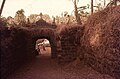 Gandaulim Fort Entrance Gate
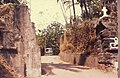 Gandaulim Fort Entrance Gate after Demolition
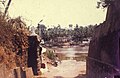 Gandaulim Fort Entrance Gate post Demolition


Notes
- Croatian author Ivo Šišević has claimed an inspiration from St. Saviour Church, Dubrovnik.[1]
- A major proponent of this theory is Croatian diplomat-historian Darko Bekić who propose that the Ragusans reached Portuguese Goa sometime between 1530 and 1535, went on to establish a colony, and declined in late seventeenth century.[1]
References
- Tomas, Lora (19 May 2014). "Distant liaisons". Himal Southasian. Retrieved 20 September 2021.
{{cite web}}: CS1 maint: url-status (link) - Andrijanić, Ivan (26 February 2018). "Hrvatska i Indija: Kulturno-povijesne i gospodarsko-političke veze". Zbornik sveučilišta Libertas (in Croatian). Zagreb, Croatia: Libertas international university. 3 (3): 351. ISSN 2584-6167.
U Goi, na zapadnoj obali indijskoga potkontinenta, trgovci iz Dubrovnika bogato su uresili crkvu Sv. Vlaha (São Braz). Na temelju toga svjedočanstva, koje navodi Jakov Lukarević (1605),[21] neki su istraživači pretpostavili postojanje dubrovačke kolonije São Braz u blizini Goe, ali za potvrdu te tvrdnje za sad nema dovoljno dokaza (Bašić, 1999: 85–93).
- Mirkovich, Nicholas (1943). "Ragusa and the Portuguese Spice Trade". Slavonic and East European Review. American Series. 2 (1): 174–187. doi:10.2307/3020140. ISSN 1535-0940. JSTOR 3020140.
- "Why this Goan village will root for Croatia". The Times of India.
- "The Croats of Goa, India". 27 May 2018.
- "Gaundalim Bridge, Goa | TPF". www.tpf.eu.
- "Gaundalim, Cumbarjua bridges opened for traffic". The Goan EveryDay.
Другой контент может иметь иную лицензию. Перед использованием материалов сайта WikiSort.org внимательно изучите правила лицензирования конкретных элементов наполнения сайта.
WikiSort.org - проект по пересортировке и дополнению контента Википедии